


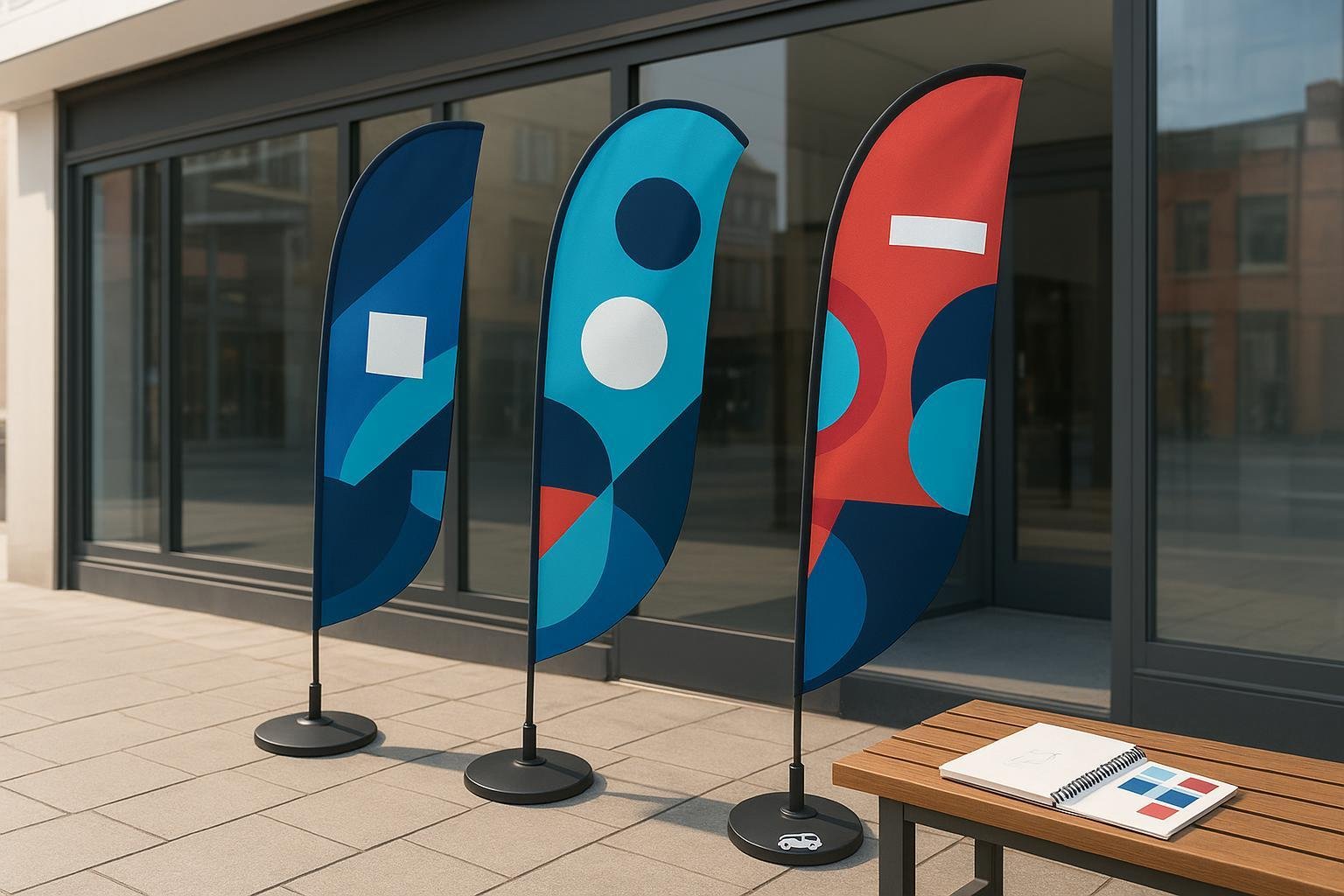
When you’re evaluating custom feather flags, the smartest move isn’t chasing the lowest sticker price—it’s optimizing total cost without compromising on build quality or delivery certainty. That’s why the hero benefit here is total cost advantage: transparent pricing, no minimum order quantity, and no hidden fees. Right alongside cost, we’ll show what real quality looks like (fabric weight, stitching, print method) and how a well-run workflow delivers flags to your door in about a week.
Value without the markup: the total cost formula that actually matters
“Cheap” only helps if the flag lasts, reads clearly from a distance, and arrives when you need it. Think of total cost as the combination of purchase price plus durability plus delivery reliability. A vendor can keep costs low by printing in-house, offering free design, and controlling logistics—but you still need proof that quality holds up.
Here’s the deal: focus on a few controllable signals that predict value.
Print method: dye-sublimation on polyester (often called digital heat printing) produces saturated, durable color because the dye bonds within the fibers rather than sitting on top.
Fabric weight: a balanced knitted polyester weight supports both drape and longevity.
Finishing: double-stitched hems and reinforced pole pockets prevent early seam failures.
Hardware match: choose poles and bases sized to your site conditions to avoid breakage.
Those elements, together with clear shipping timelines and proper packaging, form the backbone of value for custom feather flags.
What quality looks like in practice for custom feather flags
If you want a quick, reliable gauge of quality, start with materials, print, and finishing. Below is a pragmatic orientation—not universal “rules,” but norms you can use to ask sharper questions.
Fabric and GSM (grams per square meter): Many outdoor flags use knitted polyester in roughly the 110–150 g/m² range for lighter builds and up to ~200 g/m² for heavier-duty setups. Heavier construction can extend life but adds wind load and shipping weight.
Printing: Dye-sublimation on polyester creates vivid results and a soft hand feel because color infuses the fiber. Ask about heat profiles and ink systems.
Single- vs double-sided: Single-sided flags allow show-through, which is fine for many use cases. Double-sided versions typically add a blockout layer between two prints for true two-sided readability—heavier and costlier, but often worth it for storefronts and high-traffic areas.
Finishing: Look for double-stitched hems, UV-resistant thread, and reinforced pole pockets. These small details often determine whether a flag retires after months or keeps earning attention.
GSM orientation by use case:
Use Case | Typical GSM Range | Notes |
|---|---|---|
Lightweight/event flags | ~110–150 g/m² | Best flutter; moderate durability |
Moderate/heavier duty | ~150–200 g/m² | Better longevity; higher wind load |
Double-sided with blockout | ~170–230 g/m² (effective) | Heavier; ensure base selection matches |
A quick note on colorfastness and standards: Color stability in sunlight is commonly evaluated using xenon-arc light exposure and graded against blue wool standards (Class 1–5). While full lab protocols are paid content, overviews of AATCC TM16.3 explain the method and scale clearly. For a primer on how labs measure lightfastness, see the AATCC 16.3 method explained by QIMA and a general overview of accelerated light weathering using xenon-arc exposure by Intertek.
According to the AATCC explainer, the AATCC 16.3 colorfastness test exposes textiles to xenon-arc light and rates fading against blue wool standards: QIMA’s guide to AATCC 16.3.
For broader context on simulated sunlight exposure, see Intertek’s overview of accelerated light weathering with xenon-arc.
Neutralizing the objection: low price does not have to mean low quality
The fear is valid: bargain flags that fade fast, tear at the hems, or arrive late cost more in the long run. But “low price” equals “low quality” only when the build corners are cut. Here’s how to separate a good deal from a false economy:
Ask for process confirmation: dye-sublimation on polyester, with heat settings tuned for penetration and fixation. Better penetration typically correlates with more consistent color over time.
Verify finishing details: double-stitched hems, reinforced pole pockets, and thread appropriate for UV exposure. Request close-up photos or a spec sheet if you can’t see samples.
Look for quality references: If a vendor can reference lightfastness testing (e.g., AATCC 16 categories or exposure-hour summaries), that’s a sign they’re measuring what matters.
Match hardware to environment: A dense city sidewalk with gusts calls for poles and bases rated for more load than an indoor trade show. Wrong hardware causes early failure, not the print quality itself.
Durability expectations should be realistic. Outdoor textiles weather; UV and wind are unforgiving. Consumer-level flag guidance suggests that everyday outdoor use often requires periodic replacement, especially under harsh sun and constant exposure. For a conservative orientation, see a major flagmaker’s brochure noting that daily-use flags may need replacement within months depending on exposure: Annin Flagmakers brochure (2024). Professional buyers typically rotate flags, clean them, and use appropriate bases to extend life. The point is to compare total cost over the period you need visibility, not just the invoice.
Speed with certainty: from free design to delivery in 5–7 days
Speed without predictability is a gamble. A dependable workflow makes timelines repeatable. Here’s a typical process that gets custom feather flags from idea to installation quickly and reliably:
Free design request: Provide your logo, brand colors, and messaging. Good designers will prioritize legibility at distance.
Proof and revisions: You review a proof; minor adjustments ensure contrast, safe zones, and hierarchy.
Print and heat-fix (dye-sublimation): Color infuses the polyester fibers; the result is vivid and washable.
Finishing and QC: Hems are double-stitched; pole pockets reinforced; final checks confirm dimensions.
Pack for transit: Flags and hardware are cushioned and reinforced to withstand handling.
Ship with tracking: Typical production + transit window is about 5–7 days, depending on destination and carrier service.


Packaging matters more than most buyers realize. Carriers recommend right-sized boxes, filled gaps, and reinforced edges to prevent damage in transit; moisture protection helps for international routes. For a carrier perspective on packing, see DHL’s packaging guide. Long, narrow hardware packages may incur dimensional-weight pricing and additional handling surcharges; review carrier rules to anticipate costs—UPS, for example, bills by the greater of actual vs. dimensional weight and applies surcharges for elongated packages. See UPS dimensional-weight and handling guidance.
See the full price picture: total landed cost checklist for custom feather flags
Transparent pricing means you can compare quotes apples-to-apples. Use this quick checklist to build the full picture. (Keep it handy for any vendor you evaluate.)
Artwork and proofs: Is design included? How many revision rounds? Typical turnaround time to first proof?
Printing and materials: Single vs double-sided; fabric weight tier; any colorfastness/testing notes.
Hardware and base: Pole material; base type; environment fit; wind rating if provided.
Packaging: Tube vs box; sleeve/pocket reinforcement; corner guards.
Shipping: Carrier, service level, tracking; dimensional weight and potential surcharges for long items.
Duties/taxes: Cross-border considerations.
Short example: Imagine a set of three storefront flags with cross bases. If your quote includes free design and free door-to-door shipping, ask whether the base weight triggers additional handling, whether the longest side of the hardware box increases dimensional weight, and if “free shipping” covers rush options. Clarifying these details upfront prevents surprises and helps you pick the truly lowest total cost rather than the lowest-looking unit price. For quick context on how carriers price long items, refer to UPS dimensional-weight rules.
Real-world example: meeting a last-minute deadline
Disclosure: Vancke is our product.
A regional event team needed storefront visibility within a week. They submitted a free design request with brand colors on a Monday morning. By early afternoon, they received a proof and asked for one revision to enlarge the headline text for 60–80 feet readability. Approval landed Tuesday. Production (dye-sublimation print and heat fixation), stitching, and QC finished by Thursday. Packaging included reinforced edges for the hardware box and moisture protection for the flag. The shipment departed that evening with tracking and arrived Monday—six days from first contact to delivery. The team installed the flags with cross bases and water bags for pavement stability. The example shows that when design, production, and logistics are coordinated, cost efficiency and speed can coexist without sacrificing build quality. For more context on buyer experiences, see customer stories on the site’s testimonials page.
FAQs about buying custom feather flags
How far away will my message be readable? Letter height guidelines vary with font and contrast, but a common rule of thumb is roughly 1 inch of letter height for every 10 feet of viewing distance. High-contrast layouts and simple messages outperform dense copy every time.
Single- or double-sided—how should I decide? Single-sided is economical and often sufficient for sidewalk or roadside approaches where show-through is acceptable. Choose double-sided with a blockout layer when you need true two-sided readability, like storefronts with foot traffic from both directions.
How long do outdoor flags last? It depends on sun, wind, pollution, and care. Expect faster wear in high-UV or windy areas and longer life indoors or with periodic rotation. Ask vendors about any lightfastness references (e.g., AATCC-related testing) and inspect finishing quality to predict longevity.
What’s the typical timeline from design to delivery? With a smooth proof cycle, production plus transit commonly lands in the 5–7 day range. Rushes are possible but depend on capacity and carrier options.
Ready to design your flag? A free design service can help you land a clean, legible layout fast—and a predictable 5–7 day production-and-delivery rhythm keeps projects on schedule.
Written by a signage procurement specialist with years of experience helping teams specify, source, and deploy event signage.