


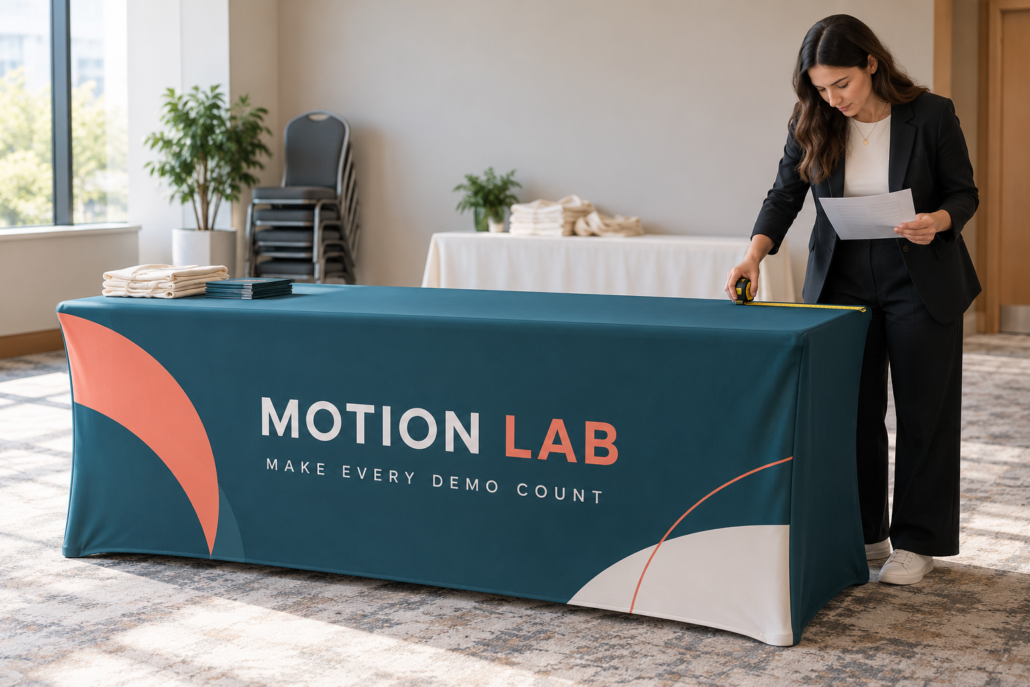
A custom tablecloth quote can look complete while leaving the decisions that matter unresolved. The request says “branded table cover,” but not whether the table is 4, 6, or 8 feet, whether staff need access underneath, which cover style is wanted, how many units are required, or what artwork is ready. The supplier then has to guess—or return a price that cannot be compared confidently with another quote.
That uncertainty is expensive for event agencies, print resellers, exhibition teams, distributors, and end brands. A vague request creates another email round, a proof that does not match the working setup, or a late change after internal approval. The fix is not a longer sales message. It is a short brief that names the physical product, the customer-facing artwork, and the order conditions before anyone compares prices.
Vancke’s current custom table cover range includes throw/standard, fitted, and stretch styles, with standard 4-foot, 6-foot, and 8-foot table dimensions shown on the product page. The site also presents three-sided/open-back and four-sided/closed-back options, a carry bag, free design support, and a proof-and-price approval step. Use those choices as the structure of the inquiry, then ask the supplier to confirm anything your venue or table does not make certain.

Recognize the vague-quote problem early
Most unclear quotes begin with a request that describes the purpose but not the deliverable. “We need branded tables for a trade show” explains the event, but it does not tell a supplier what to manufacture. “Please quote six 6-foot fitted covers, four-sided, with the attached logo and delivery to our venue by the confirmed event date” is much easier to review.
Look for five warning signs in your draft. The table size is assumed rather than measured. “Tablecloth” is used without naming a cover style. Storage access is left to the supplier. The artwork is described as “similar to last time” without a current file or proof reference. The quantity and destination are missing. Any one of these gaps can make two apparently similar prices describe different products.
This does not mean every detail must be final before you ask a question. It means you should label what is fixed, what is under consideration, and what you want the supplier to recommend. A useful inquiry can say, “We have a venue-supplied table and need help confirming the correct style,” as long as it includes the measurements and the job the cover must perform.
Start with the table you will actually cover
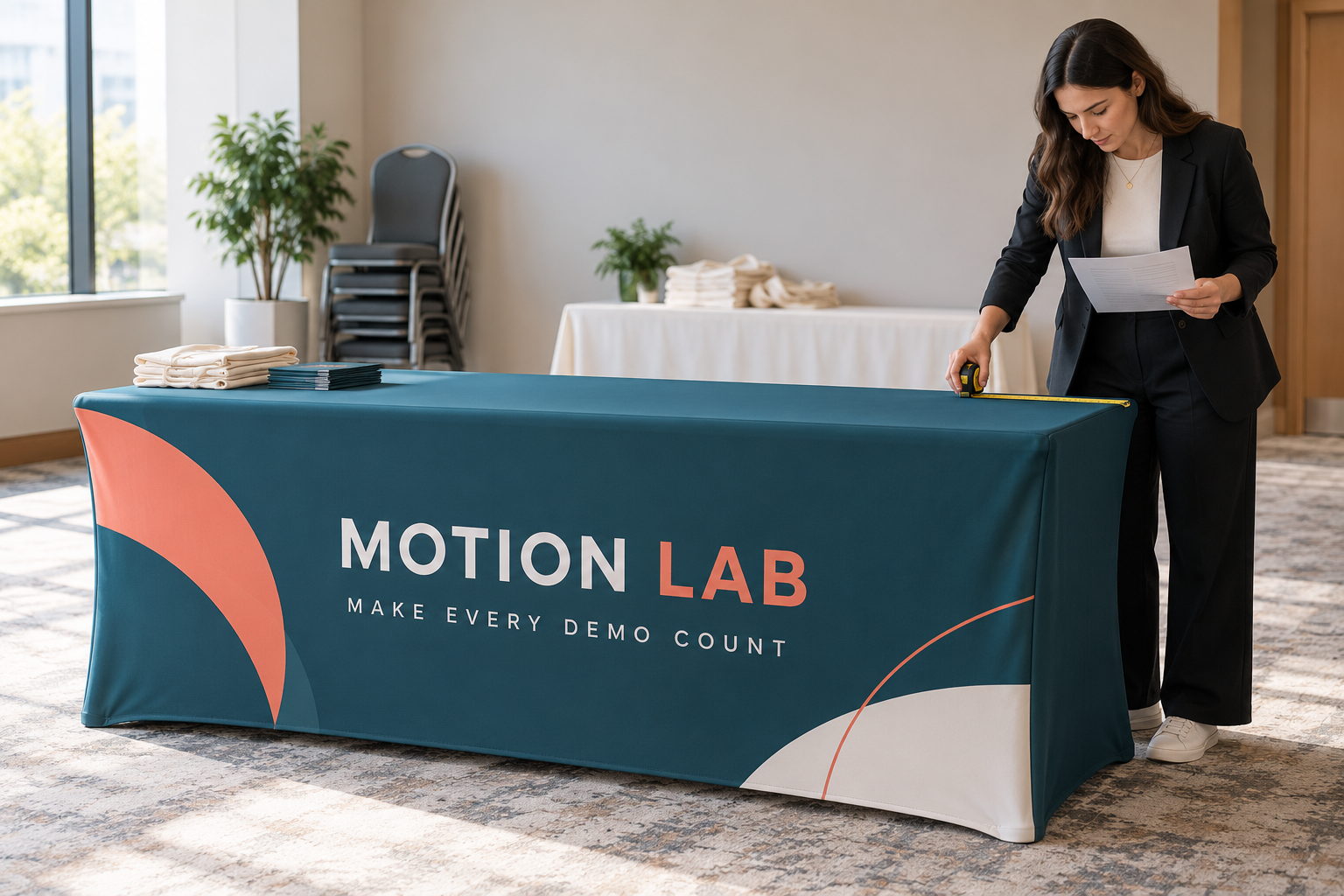
Write down the table length, width, and height instead of relying on “standard.” Vancke’s product page shows 4-foot, 6-foot, and 8-foot table dimensions for its listed cover types. A venue may use a table described by the same nominal length but with different depth, height, legs, or surrounding equipment. If the table is supplied by a venue, ask for its specification or measure it when access is possible.
Add one photograph or simple sketch when the table will sit beside a registration queue, demonstration unit, brochure rack, or product samples. The photograph is not a replacement for the supplier’s template. It gives the designer context about how the cover will be seen and what the staff must reach during the event.
If the order is for multiple locations, list the table dimensions by location. Do not assume that one approved cover will fit every branch just because the tables are all called “6-foot.” A short measurement record prevents a multi-location quote from hiding a fit decision that still belongs to the buyer.
Name the cover style instead of saying “tablecloth”
Vancke presents three broad styles: throw/standard, fitted, and stretch table covers. They are not interchangeable labels in a quote. A throw/standard cover uses a classic drape. A fitted cover follows the table’s contours. A stretch cover is described as a tight, body-hugging fit. Ask for the style that matches the visual and operational requirement, or request a recommendation between two named options.
Make the choice explicit in the brief: “Please quote fitted and stretch versions for the same table dimensions,” or “Please recommend whether a standard throw is suitable for this temporary registration setup.” This gives the supplier a clear comparison and gives your team a clear reason for any price difference. It also avoids approving a visual mockup that shows one construction while the quote describes another.
Keep style and artwork decisions separate. A different cover construction can change how a logo, slogan, QR code, or graphic sits on the finished fabric. Approve the product form and the customer-facing design together, not in two disconnected email threads.
Specify what must remain accessible underneath
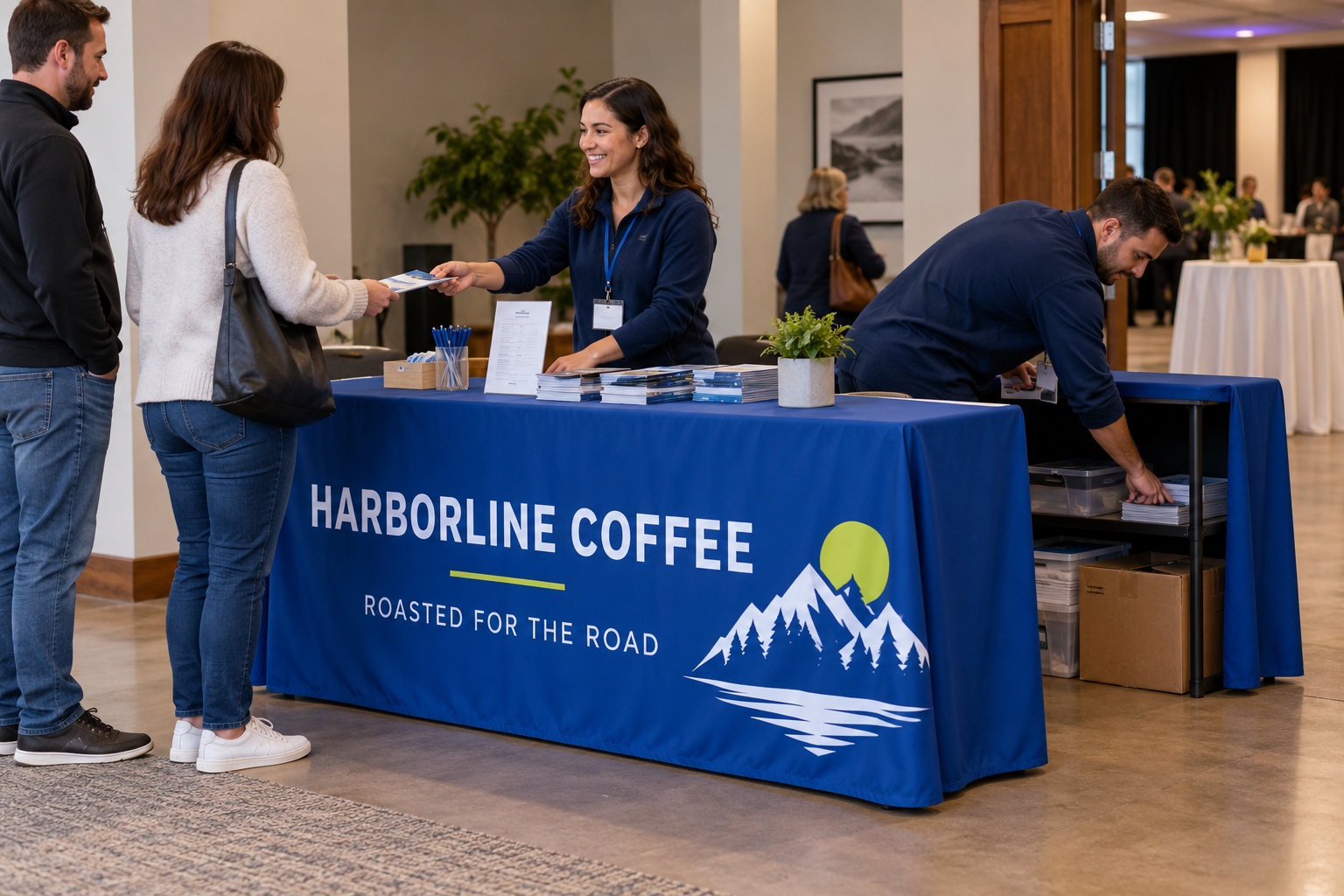
Back-side access is a practical decision, not a finishing preference. Vancke describes a three-sided/open-back cover as an option that keeps supplies accessible, while a four-sided/closed-back cover provides full coverage. If staff will retrieve brochures, samples, cables, or personal items, write that requirement in plain language.
Describe the action: “Staff need to reach storage from the rear during the event,” or “The contents under the table must be concealed from visitors.” Then ask the supplier to quote the corresponding back-side construction. Avoid asking only for a “clean look,” because both an open-back and a closed-back setup can look tidy in a static image while working very differently in use.
For agencies and resellers, record this as a customer approval item. The end brand may prefer a fully covered table, while the event team may need quick access. Asking both parties before artwork approval is cheaper than discovering the conflict during setup.
Make the artwork request concrete
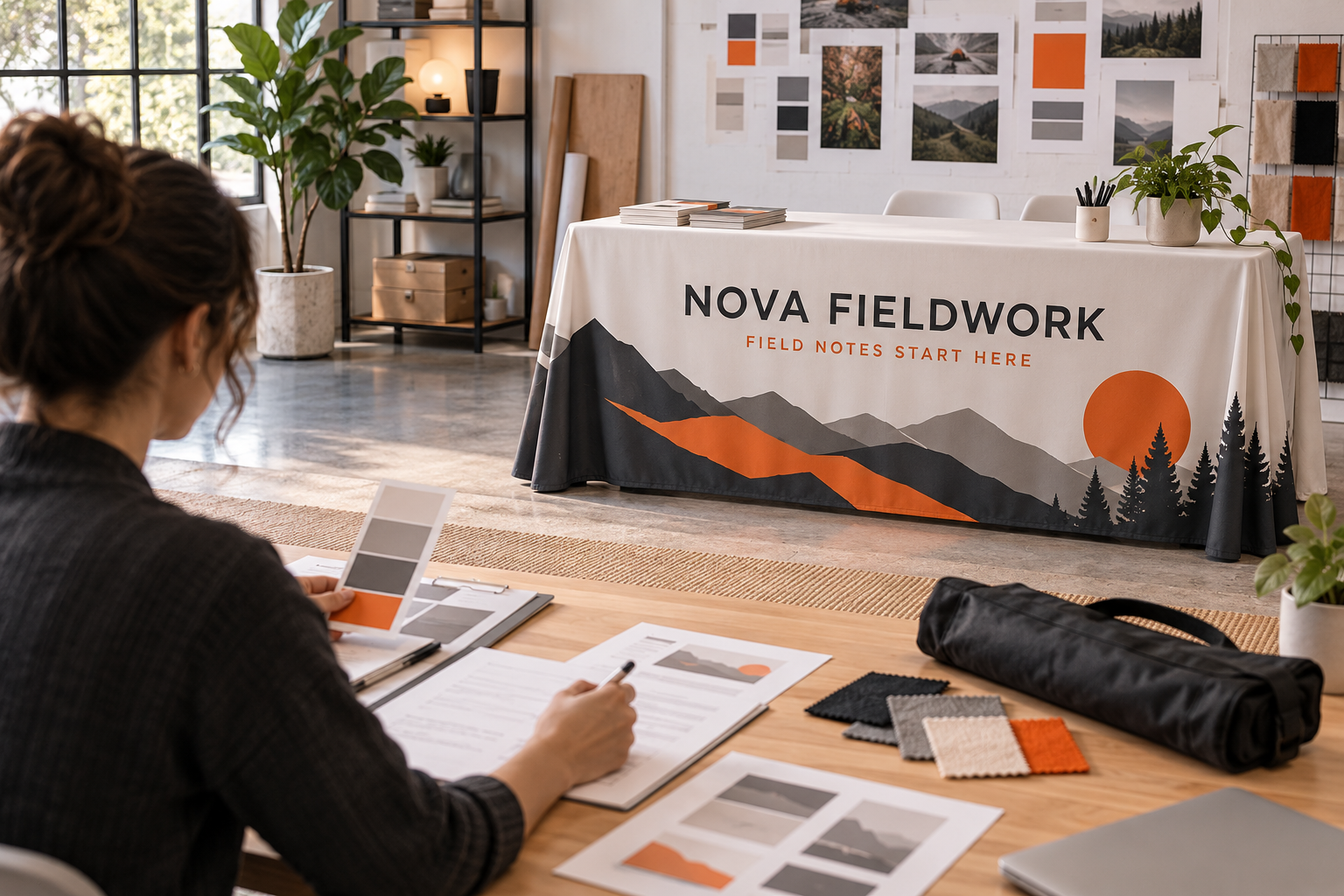
Attach the current logo or artwork file and state what the cover must show. Include the exact customer brand name, slogan or message, preferred colors, and any QR code or product image. If the artwork is still being developed, say so and ask for design support rather than presenting an unfinished file as production-ready.
Vancke’s product page describes full custom printing and free artwork review or design support, and its ordering flow includes a digital proof and price approval before production. Use that proof as a checkpoint. Check the spelling, logo proportions, color direction, message hierarchy, and placement on the chosen cover style. A proof should answer “what will be printed on this product?” rather than merely show a logo floating beside a generic table.
For print-preparation questions, Adobe’s guide to printer’s marks and bleeds is a useful non-supplier reference. Use the supplier’s textile template and instructions for the final file; a general paper-print guide cannot replace product-specific production requirements.
Put quantity, destination, and timing in the same request
State the quantity for each cover type and location. If you need one cover for a pilot event and more later, separate the initial quantity from the possible reorder. A supplier can then distinguish a confirmed request from a future scenario instead of pricing both as if they were already approved.
Include the delivery destination and the date the display must be ready at the venue. Treat that date as a requirement to confirm, not as proof that a particular turnaround is guaranteed. Ask the supplier to confirm production and delivery timing for the actual order, destination, quantity, and approved artwork.
Also note whether the carry bag is required. Vancke’s product page describes a complete set that includes one custom tablecloth and one carry bag. If your team transports the cover between events, include the carry requirement in the comparison so one quote does not appear cheaper only because an accessory was omitted.
Use this one-page custom tablecloth quote brief
Copy the fields below into an email, inquiry form, or internal purchase request. Mark unknowns as questions instead of leaving them blank.
- Use: event type, venue, visitor approach, and what the staff will do behind the table.
- Table: length, width, height, supplier or venue source, and one photograph or sketch.
- Cover style: throw/standard, fitted, stretch, or two options to compare.
- Back side: three-sided/open-back for access or four-sided/closed-back for full coverage.
- Artwork: current logo, exact wording, colors, QR code or image requirements, and proof approver.
- Quantity: confirmed units, locations, and any separate future reorder.
- Transport: whether a carry bag is needed for the event team.
- Timing: venue-ready date, delivery destination, and the request for timing confirmation.
- Questions: any choice where you want the supplier to recommend an option.
This format helps an agency keep separate client jobs separate, helps a reseller compare like with like, and helps a brand team see which decisions are still open. It does not force a construction choice before the venue information exists. It makes the uncertainty visible so the next response can resolve it.
Compare the supplier responses, not just the prices
When the replies arrive, first compare the described product. Are the table dimensions the same? Is the style the same? Is the back-side construction included? Does the artwork proof show the same customer-facing message? Is the quantity identical, and is the carry bag included or omitted?
Then compare the decision evidence. A useful response should make clear what the supplier understood and what still needs approval. If a low price depends on an assumed size, a different cover style, or an unconfirmed delivery window, it is not yet a comparable offer. Ask one precise follow-up instead of trying to infer the missing detail.
Keep the approved brief, proof, quote, and final product choice together for the job. On a reorder, update the table, artwork, quantity, and event information before sending the old files again. Reusing a clear brief is efficient; reusing an outdated assumption is how a previously solved problem returns.
Turn the brief into a qualified inquiry
Ready to request a custom tablecloth quote? Send Vancke the actual table dimensions, preferred cover style or comparison request, open-back or closed-back requirement, artwork, quantity, carry-bag need, delivery destination, and venue-ready date through the free design request. You can also review the custom table cover options before submitting the details.
Ask for a digital proof and a price that clearly identifies the product configuration. If you are unsure which style or back-side construction fits the setup, say exactly what staff and visitors need to do and ask for a recommendation. A complete brief does not guarantee that every project is simple, but it gives Vancke the information needed to answer the real purchasing question.