


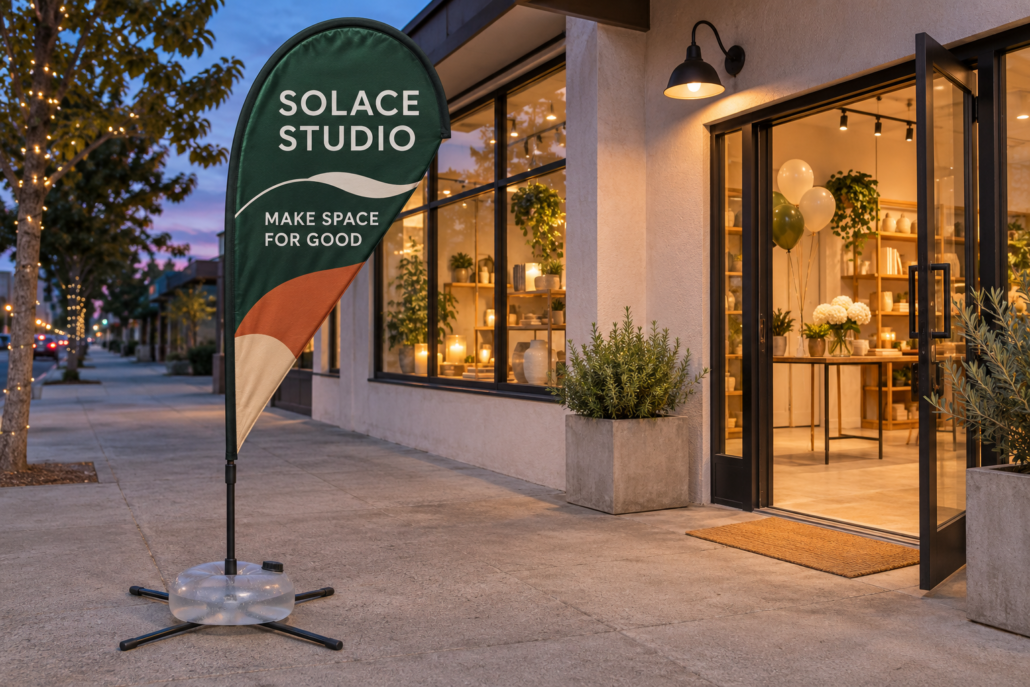
A teardrop flag order can be delayed by a brief that sounds specific but still leaves the physical setup undecided. “We need branded flags for an event” does not tell a supplier what surface the base will meet, which direction visitors will approach from, whether one face is enough, or what the team must carry to the venue.
Those missing decisions create more than email. They can produce a proof that looks right but does not match the site, a base that does not suit the ground, or a delivery plan that cannot be checked against the event date. The safer purchasing move is to write a short brief around the finished display and the job it must perform.
Vancke lists custom teardrop flags with custom printing, multiple sizes and base options, and single- or double-sided constructions. The product page also describes a turnkey kit containing the printed fabric, a mounting base, an interlocking pole set, and a carry bag. Use those published choices as the skeleton of your inquiry, then mark every site-specific unknown as a question instead of letting the supplier guess.
1. Start with the display job, not only the product name
Write the first sentence so a person who was not in the planning meeting can understand the display’s role. State whether the flag is meant to identify a storefront, guide visitors to a registration point, mark a sports activity, support a market entrance, or make a trade-show position easier to find.
This is not a branding exercise. It determines what the buyer needs to inspect later. A wayfinding flag needs a short message that can be understood while someone is moving. A display beside a staffed booth may need a logo and one offer, while a roadside location may need the brand to remain recognizable from a longer approach. A clear job also keeps the inquiry focused on qualified attention rather than on adding more words to the fabric.
2. Name the actual ground surface
“Outdoor event” is not a base specification. A venue can include a paved entrance, a grass lawn, a sandy activity area, and a hard indoor floor in the same schedule. Write the surface where each flag will stand and attach a site photograph when the description could be interpreted in more than one way.
For indoor or other hard flooring, the approved configuration is a four-arm cross base with a refillable water-weight bag centered over the base around the pole. The base, pole connection, fabric, and ballast should be treated as one complete setup. A standalone square slab or round pedestal does not answer the same physical question.
For grass, soft soil, or sand, the approved configuration is a ground-spike base with its pointed shaft visibly inserted into the ground. A spike resting on top of grass or sand is not an installed anchor. Put the surface and the base together in the brief so the proof and the quotation can be checked against the same assumption.
3. Confirm where the first reader will stand
Sketch the approach to the display. Is the first reader coming from the parking area, one side of an aisle, a queue, a sports field, or a storefront path? Add the intended viewing direction to the site photo or a simple plan. This turns “high visibility” into a check the buyer can actually perform.
Then decide whether the message must read correctly from one direction or from both. Vancke lists single-sided and double-sided teardrop constructions. Ask for the construction that matches the traffic pattern, especially when visitors can pass on both sides or when a mirrored reverse would make a word, URL, or QR code difficult to use.
Keep the customer-facing message short. The flag should help a visitor recognize the destination or offer, while the landing page, booth conversation, or inquiry form handles the detail. If the design needs a paragraph to explain itself, the brief has not yet separated recognition from conversion.
4. Write the printed surface as a production decision
Attach the current logo or artwork and write the exact customer brand name, slogan, colors, and any required call to action. Do not write “use the usual design” when the job has a new venue, product launch, or audience. The supplier needs to know what must appear on the fabric and who can approve the final proof.
If the artwork is still an idea, Vancke’s free design request asks for the product, a description of the design idea, style, and preferred colors. That gives the design conversation a useful starting point. You can also provide a simple reference image or a rough hierarchy, but label inspiration separately from the words that must be printed.
For any artwork that uses bleed, trim, or other print-preparation decisions, follow the supplier’s product-specific template and instructions. A general artwork reference cannot replace the final proof for this exact flag and construction.
5. Request the complete kit, not a loose fabric panel
List the components you expect to receive: printed teardrop fabric, pole set, site-matched base, and carry bag. Vancke describes these as part of its turnkey teardrop kit. Put the list in the inquiry and compare it with the quotation before approval.
Also assign ownership for the physical setup. Who carries the bag? Who checks the pole connections? Who fills and positions the water-weight bag on hard flooring? Who confirms that the spike is actually inserted on soft ground? These are operational questions, not a request for unsupported product guarantees. They make it less likely that a correct order will become an incomplete display at the venue.
6. Put size and quantity beside the location
State the preferred size, quantity, and location together. If two venues need different footprints, list them as separate lines. If you are unsure about the size, describe the viewing distance and ask the supplier to recommend an option; do not hide that decision behind the word “standard.”
For agencies and distributors, separate confirmed quantities from possible reorder quantities. A supplier can then quote the real request without treating an unapproved future scenario as part of the order. It also gives the buyer a clean record when the same brand appears at several sites with different base conditions.
7. State the venue-ready date without promising a turnaround
Include the date the display must be ready at the venue, the delivery destination, and any receiving restrictions. The date is a requirement to confirm, not evidence that a particular production or shipping speed is guaranteed. Vancke’s ordering page says timing depends on quantity and destination and that the estimated delivery schedule for larger orders is stated in the quote.
Ask the supplier to confirm the production and delivery plan for the actual quantity, destination, approved artwork, and requested date. If the event is time-sensitive, leave room for proof approval, payment, transit, and local receiving rather than treating dispatch as the same thing as venue arrival.
8. Use the proof as a decision checkpoint
Vancke’s published ordering flow starts with a quote, then a proof, proof approval, an invoice, and shipment with tracking. Treat the proof as the point where the brief becomes a real product decision. Check the flag shape, the customer-facing message, the chosen side construction, the site-matched base, and the components listed in the quote.
Ask a colleague who knows the venue to review the proof from the intended approach. They should be able to answer: Can I recognize the brand? Is the main action clear? Does the layout still work on the teardrop silhouette? Is the selected base the one that belongs on this surface? If any answer is uncertain, resolve it before approval instead of hoping the physical item will make the decision easier.
9. Keep weather and venue rules as separate checks
A product selection is not a site-safety approval. Before the event, confirm the venue’s rules, the ground conditions, access paths, and who can pause or remove the display when conditions change. The U.S. National Weather Service explains that high winds can move objects and pose safety risks; that general reminder does not define a safe operating limit for a particular flag or location.
Record the venue contact and the person responsible for the decision. Do not turn a general weather resource into a supplier-specific promise. The useful purchasing result is a clear handoff: the right product brief, a confirmed site configuration, and a named owner for the final on-site decision.
10. Send one decision-ready inquiry
Use this structure when you request a quote or free design review:
- Display job: what the flag must help visitors recognize or do.
- Site: venue, exact position, visitor approach, and a photograph or sketch.
- Surface and base: hard floor with cross base and centered refillable water-weight bag, or grass, soft soil, or sand with a pointed ground spike inserted into the ground.
- Construction: preferred size and whether single- or double-sided legibility is required.
- Artwork: current logo, exact words, colors, call to action, and proof approver.
- Kit: printed fabric, pole set, site-matched base, and carry bag.
- Order: quantity, delivery destination, receiving restrictions, and venue-ready date.
- Open questions: the decisions where you want Vancke to recommend a configuration.
Before paying, compare the returned quote with this list. If the product, base, side construction, quantity, delivery assumption, or artwork proof is different, ask one precise question and update the brief. A lower-looking price is not comparable when it describes a different display.
Turn the brief into a qualified inquiry
Ready to plan a custom teardrop flag? Send Vancke the site surface, viewing direction, preferred size, construction, customer artwork, quantity, destination, and venue-ready date through the free design request. Review the custom teardrop flag options and the published ordering steps so the request, proof, approval, payment, and delivery questions stay connected.
The goal is not to make the inquiry longer. It is to make the important decisions visible early enough for the supplier to quote the real display and for your team to approve the real setup. That is how a product page visit becomes a cleaner, more attributable conversation about the flag your venue can actually use.