


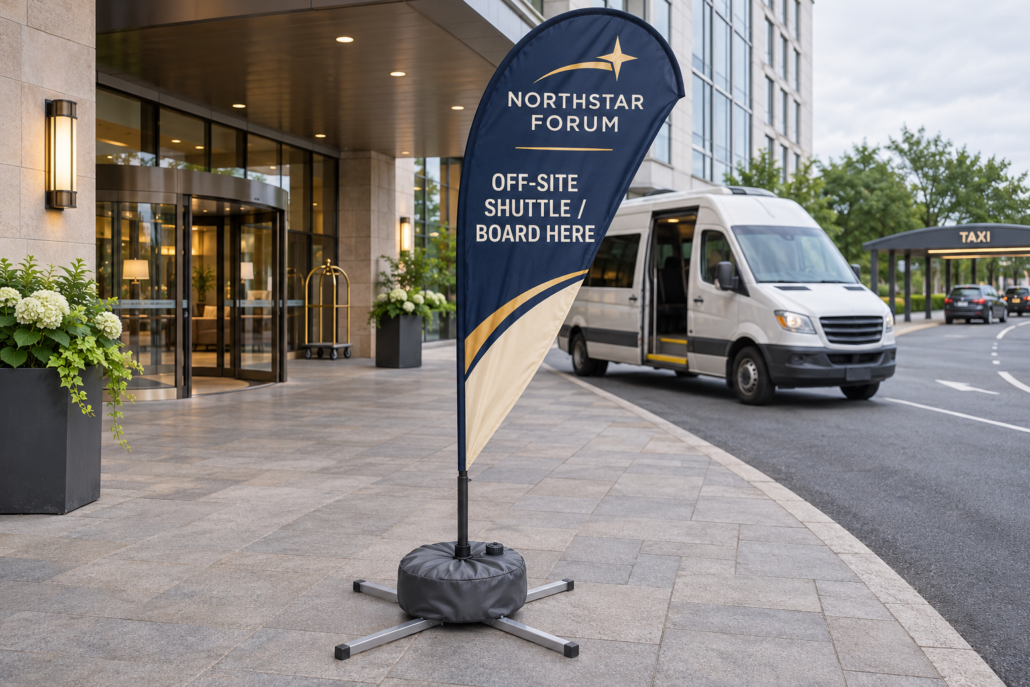
At a conference hotel, the shuttle boarding point rarely competes with only one other sign. Guests may be looking at the hotel entrance, a taxi lane, rideshare vehicles, a tour coach, and several temporary instructions at the same time. A flag that says only the event name can look branded while still leaving the most important question unanswered: where should the passenger stand?
That is a communication problem before it is a product problem. A custom teardrop flag can become a useful boarding marker when the brief makes the destination, action, viewing direction, and physical setup explicit. It should not be treated as a guarantee of traffic control or passenger safety. The goal is to give the event team and supplier a display decision that can be checked before production.

Start with the boarding decision
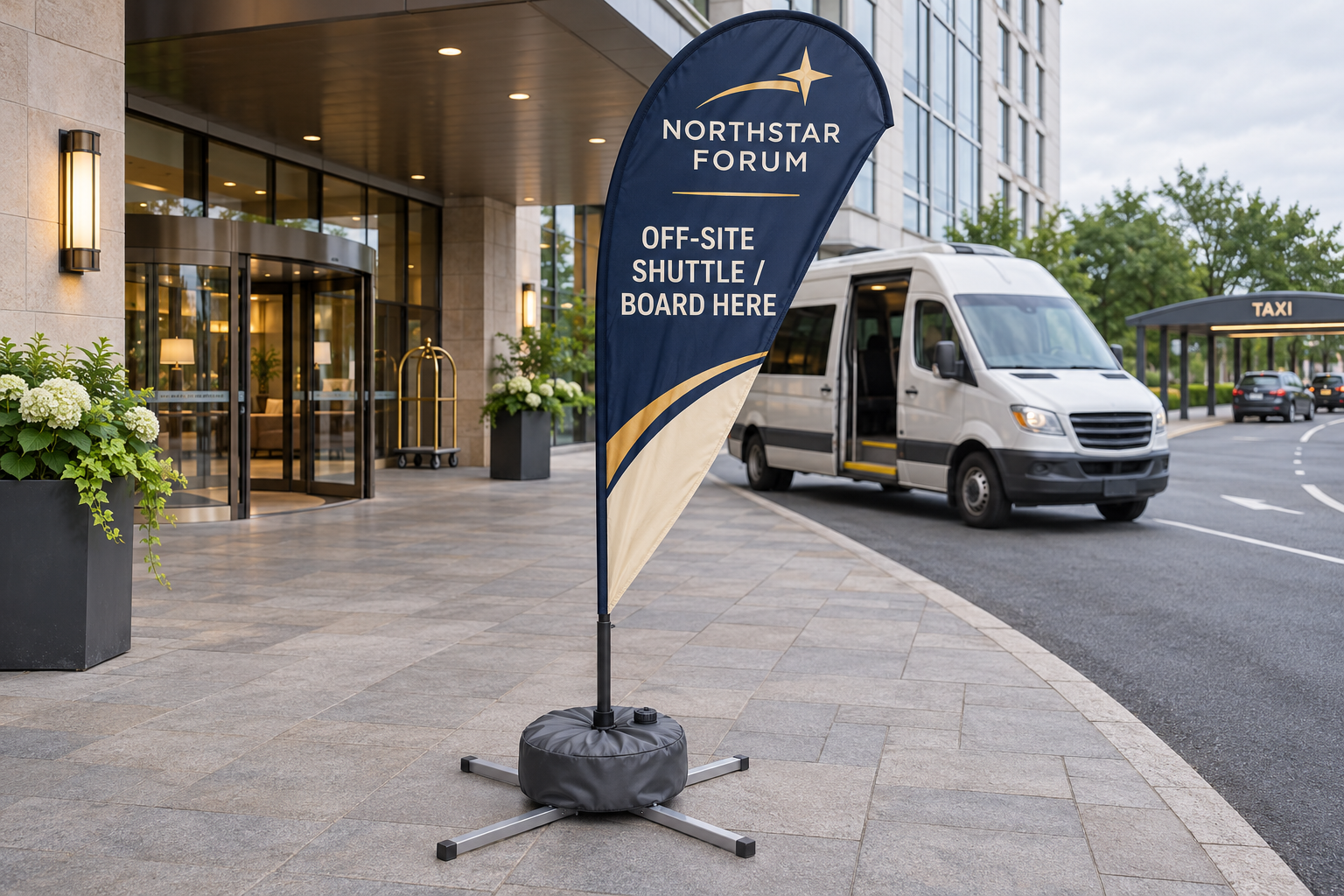
Write the decision in one sentence before choosing the artwork: “Conference attendees should recognize the off-site tour shuttle boarding point before they join the hotel arrival flow.” That sentence is more useful than “make the flag highly visible” because it tells the team what the proof must demonstrate.
Separate three pieces of information:
- Identity: which event or group the marker belongs to.
- Action: what the attendee should do, such as BOARD HERE.
- Destination: which shuttle, tour, or off-site activity is served.
Do not force every operational detail onto the fabric. A departure time, vehicle number, accessibility instruction, contact number, and late-arrival policy may belong on a staffed desk, printed ticket, event app, or separate temporary notice. The flag should carry the recognition and next action that a person needs at the decision point.
Map the approach before you request a quote
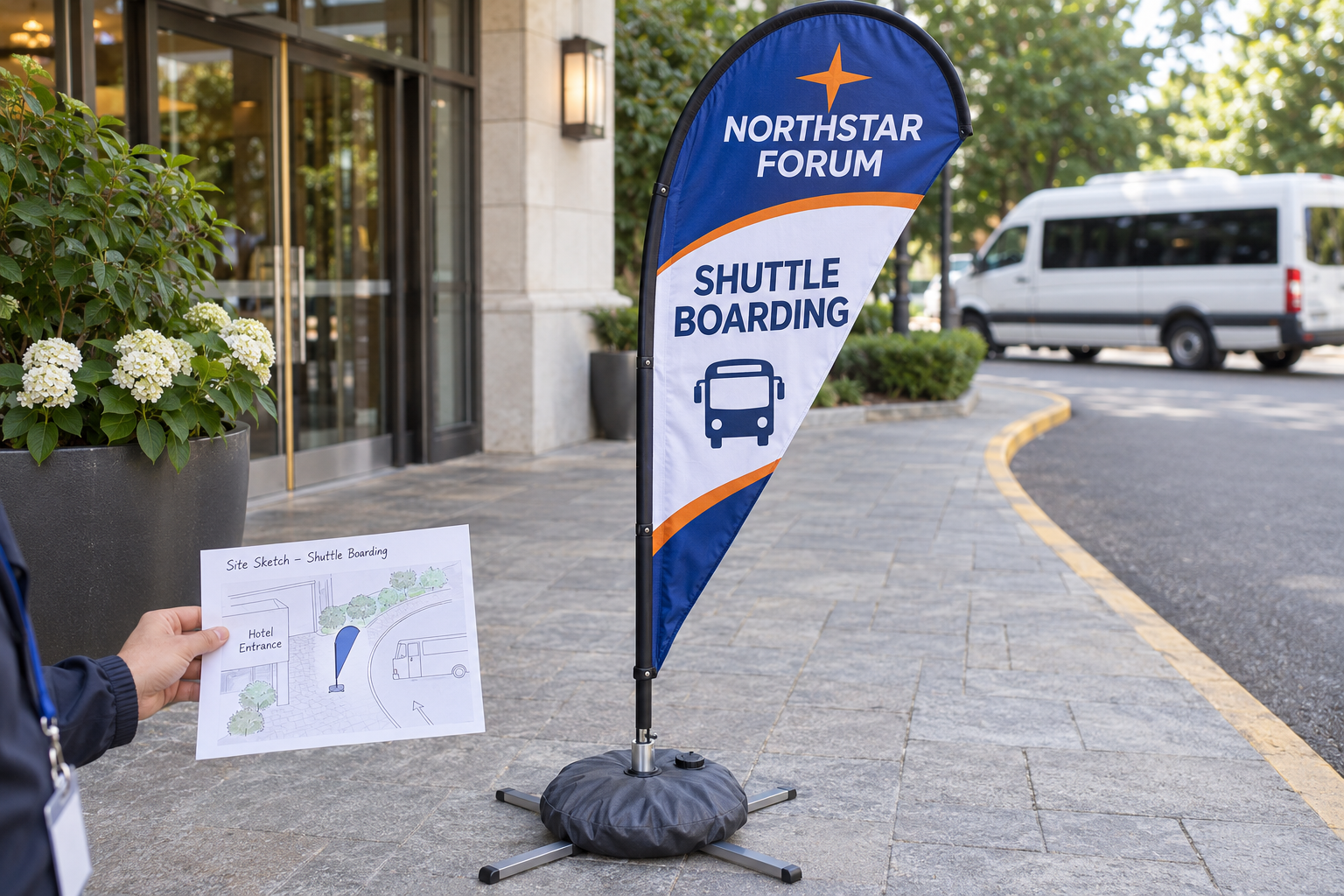
A hotel forecourt is not a single viewpoint. Attendees may leave through the lobby, arrive from a parking area, cross from a taxi stand, or follow a temporary queue. Attach a simple site sketch or annotated photograph to the inquiry and mark:
- the hotel entrance and the shuttle vehicle position;
- the direction from which the first passenger approaches;
- the taxi, rideshare, coach, or service lanes that could be confused with boarding;
- the space available for the display and the passenger queue;
- the person responsible for checking the setup before boarding begins.
This is a planning method, not a promise that a flag will manage traffic. It gives the supplier enough context to recommend a size, side construction, and base while keeping the event team responsible for venue approval and on-site decisions.
Put the action before the decoration
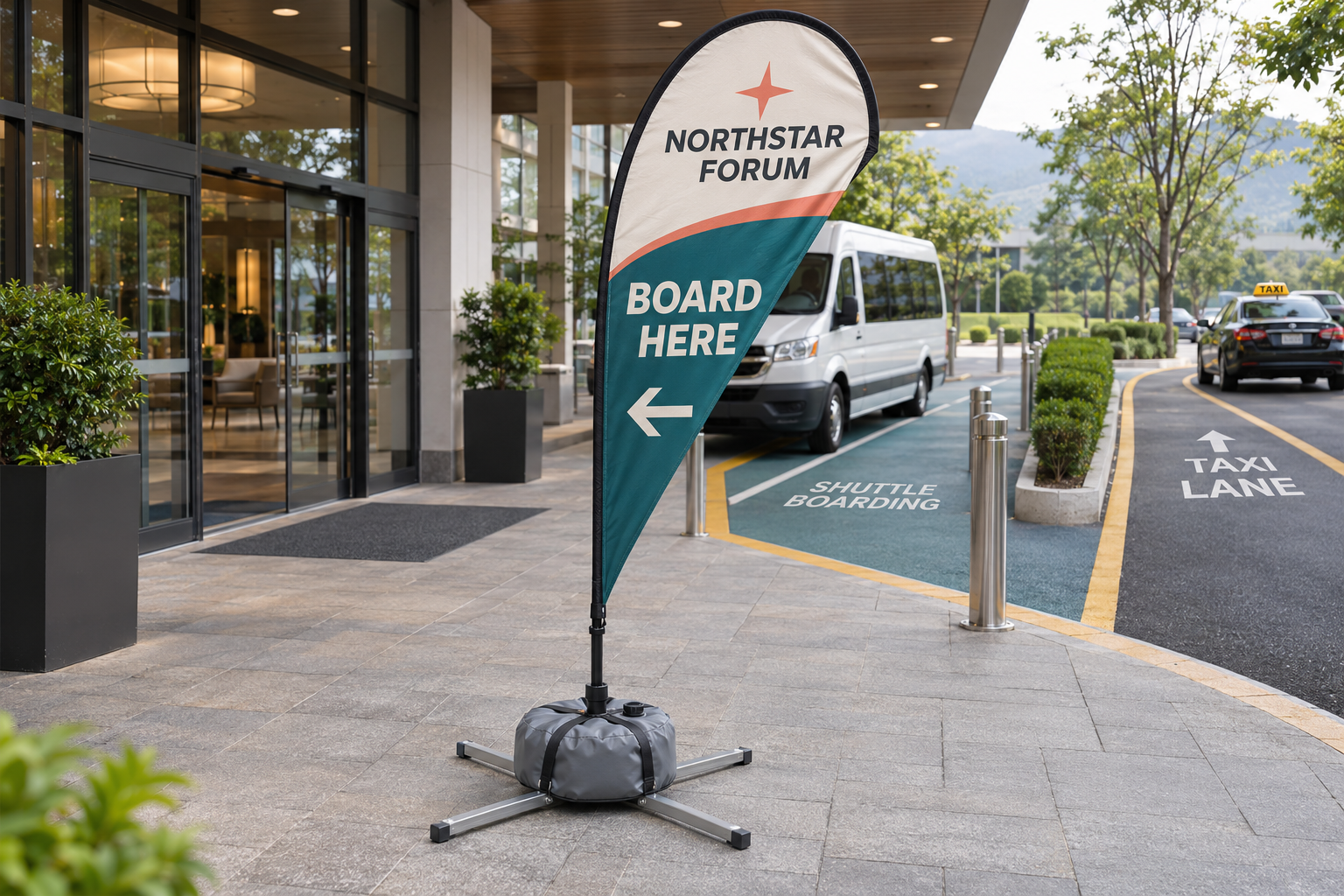
For a temporary boarding point, the first readable line should normally answer the passenger’s immediate question. “OFF-SITE TOUR SHUTTLE” identifies the service; “BOARD HERE” identifies the action. The event name can reinforce the message without becoming the only large element.
Keep the message short enough to inspect from the real approach. In the proof, review the flag at the distance and angle where an attendee will first encounter it. If the person needs to stop, walk closer, or read a paragraph before understanding the instruction, the layout is asking the product to do too much.
Use the fictional customer brand, event theme, and slogan in the artwork brief. For example, a design can use NORTHSTAR FORUM as the event identity and OFF-SITE SHUTTLE / BOARD HERE as the operational message. The customer-facing surface should not carry a supplier logo in place of the buyer’s brand.
Choose the teardrop format around the site
Vancke describes custom teardrop flags as a closed, tensioned teardrop-shaped display with custom printing, multiple sizes, base options, and single- or double-sided constructions. Those choices matter because a shuttle point has both a physical site and a viewing pattern.
For an indoor lobby threshold, covered hotel forecourt, paved entrance, or other hard surface, confirm the approved configuration in the brief: a four-arm cross base with a refillable water-weight bag centered over the base around the pole. The proof should show the flag, pole, cross arms, and water-weight bag as one complete setup. A generic circular stand or hidden base does not answer the same question.
For grass, soft soil, or sand at an outdoor activity venue, Vancke’s approved visual configuration is a ground-spike base with its pointed shaft visibly inserted into the ground. That is a different site decision from a paved hotel forecourt. If the conference uses several boarding locations, list each surface separately instead of ordering one generic base for every stop.
Vancke also lists wheel-car-tire hardware on the product page. Treat that as a site-specific option to discuss with the supplier, not as a default recommendation for a hotel arrival lane. The quote should state the exact base and the surface it is intended to meet.
Decide whether one side is enough
A single-sided teardrop construction may be appropriate when the hotel has one controlled passenger approach and the reverse view does not need to carry a separate message. The current Vancke product page notes that single-sided fabric can show the design through to the reverse side in a mirrored layout.
Ask for double-sided construction when the marker may be approached from both directions or when the words must read correctly on either side. The page describes double-sided construction as a blockout configuration designed for correct legibility from both sides. That product fact does not remove the need for a site check: the event team still needs to decide where each face points and what the passenger sees first.
Write the requirement plainly: “The event name and BOARD HERE instruction must read correctly from the hotel entrance and the taxi-lane approach.” This is more actionable than asking for maximum visibility, which does not identify the message, side, or viewing direction that must be tested.
Use the proof as a pre-event problem-solving checkpoint
Vancke’s ordering flow starts with a quote, followed by a proof, proof approval, invoice, and shipment with tracking. Treat the proof as the moment when the shuttle plan becomes a production decision.
- Message check: Can an attendee identify the event, the shuttle destination, and the boarding action without reading a long explanation?
- Approach check: Does the design face the first passenger approach, and is the reverse side acceptable for people coming from the other direction?
- Surface check: Does the shown base match the paved hotel forecourt, grass, soil, or sand where the flag will stand?
- Assembly check: Does the proof show the printed fabric, pole, base, and water-weight bag or ground spike as a complete display?
- Ownership check: Has the venue approved the placement, and is one named person responsible for the final setup review?
If the proof fails, do not solve the problem by adding more copy. First identify whether the issue is the product position, base, side construction, message hierarchy, or site assumption. Send one consolidated revision from the named approver so the supplier is not working from conflicting instructions.
Turn the site plan into a quote-ready request
A supplier can respond more precisely when the inquiry contains the decisions that change the display. Use this structure:
- Event and boarding job: event name, shuttle or tour destination, and the exact passenger action.
- Venue: hotel, forecourt or lobby location, entrance reference, and the first approach direction.
- Surface: paved hard floor, grass, soft soil, or sand, with an annotated photo or sketch.
- Format: preferred size, quantity, single- or double-sided requirement, and whether several stops need different artwork.
- Base: the site-matched configuration to quote, including the four-arm cross base and centered refillable water-weight bag for hard flooring when applicable.
- Artwork: customer logo, event name, exact words, colors, arrow or icon, and the person who approves the proof.
- Delivery: destination, receiving hours, venue-ready date, and any hotel delivery restrictions.
- Open question: the specific choice where you want Vancke to recommend a size, side construction, or base.
Vancke’s free design request asks buyers to choose a product, describe the design idea, share style preferences, and select prevalent colors. Those inputs are a useful starting point when the event team has a site plan but not a production-ready file. Add the operational message and approach sketch so the design discussion remains connected to the boarding task.
Keep weather and venue responsibility visible
A teardrop flag brief should not become an unsupported safety promise. The U.S. National Weather Service notes that high winds can move objects and pose safety risks. That general information is useful as a reminder to check the event forecast, venue rules, access paths, and the person authorized to pause or remove a display when conditions change. It does not establish a safe operating limit for a specific Vancke flag, base, hotel, or event.
Ask the venue to confirm placement rules and keep the shuttle operator’s instructions separate from the product quote. The display can identify the boarding point; it does not replace staff, transport procedures, or local site requirements.
Next step: request the right proof
If the boarding point is still being confused with a taxi or hotel arrival lane, send Vancke a short brief built around the real decision: where the passenger approaches, what they must read first, which surface the base will meet, whether both sides must read correctly, and when the display must be ready.
Start with the custom teardrop flag options, then submit the event details through the free design request if the artwork needs help. Review the ordering steps so the quote, proof approval, payment, and shipment tracking remain connected.
Your final request can end with one sentence: “Please recommend the size, side construction, and base for this hotel forecourt, then send a proof showing the exact customer message from the attendee approach.” That gives the supplier a defined problem to solve and gives the event team a defined result to approve.