



Most custom teardrop flag delays do not begin on the production floor. They begin with an incomplete brief. A buyer sends a logo and a quantity, but leaves the supplier to guess the viewing direction, site surface, available height, base type, and whether the reverse side must read correctly. Each unanswered question creates another email, another artwork revision, and another chance to order hardware that does not fit the venue.
This guide gives event teams, print resellers, distributors, and multi-location marketers a practical eight-part brief they can complete before requesting a quote. It is not a substitute for a site safety assessment or an approved production proof. It is a way to make the first supplier conversation more complete, reduce avoidable revisions, and compare quotations on the same basis.


1. Define the job before choosing the flag
Start with the operating situation, not the catalog image. Write down where the flag will be used, who must see it, how long it will stay in place, and who will transport and install it. A flag beside a registration desk has a different job from one beside a roadside entrance. A touring event also places more value on compact packing and repeatable setup than a display that remains at one location.
A useful one-sentence job definition looks like this: “We need two portable entrance markers for ten regional trade shows, viewed from both directions and installed mainly on indoor concrete.” That sentence already informs quantity, portability, viewing direction, and base selection. It gives the designer a clearer target than “make two flags with our logo.”
2. Record the available height and traffic path
Confirm the usable height at the actual location, including ceiling fixtures, door canopies, booth regulations, and the space occupied by the base. Vancke lists teardrop flag systems in four nominal overall heights: 225 cm (7.5 ft), 275 cm (9 ft), 380 cm (12.5 ft), and 450 cm (15 ft). Availability and final dimensions should still be confirmed on the quotation and proof.
Height alone does not determine visibility. Note whether visitors approach from the front, pass from both directions, or view the display from across a parking area. Mark nearby walls, vehicles, furniture, and other signs that could hide the lower part of the graphic. This information helps the designer place the most important message where it is more likely to remain visible.
3. Choose single-sided or true double-sided construction
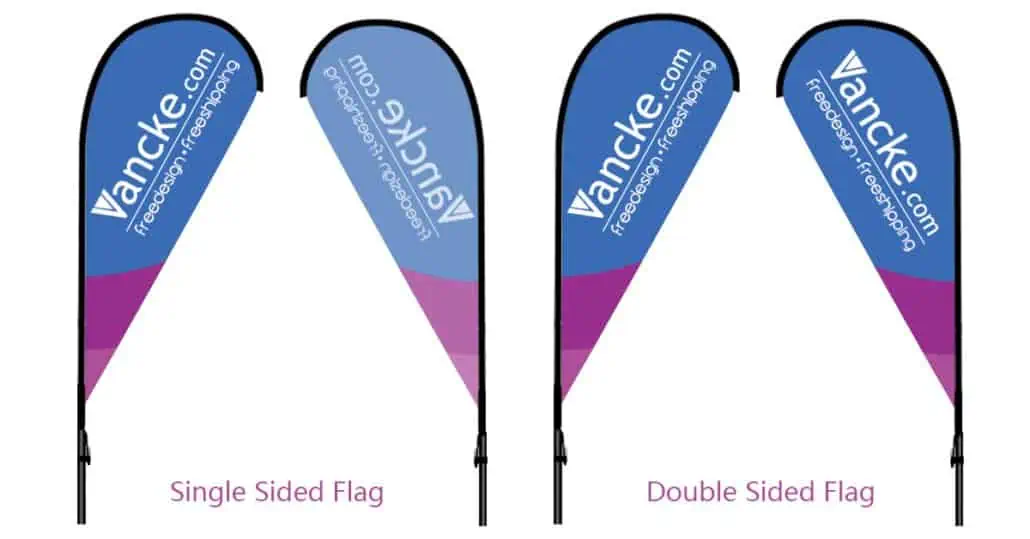
Single-sided and double-sided flags solve different communication problems. A single printed layer is the simpler option when the primary audience approaches from one direction or when reverse-side mirrored artwork is acceptable. Some of the printed color can show through to the reverse, but words and directional symbols will appear mirrored.
A true double-sided flag uses two printed panels with an internal blockout layer so each side can carry correctly oriented artwork. That is the better starting point when visitors approach from opposite directions, when a phone number or URL must read correctly on both sides, or when each side needs a different message. It also adds material and weight, so it should be specified deliberately rather than treated as an automatic upgrade.
Put the decision in the brief: “single-sided reverse accepted” or “true double-sided, correct reading on both faces.” If the two sides use different artwork, label them Side A and Side B and show the expected traffic direction.

4. Match the base to the surface
The base is part of the display system, not an accessory to choose at the last minute. For indoor floors and hard surfaces, a folding cross base provides a freestanding option. When it will be used outdoors, discuss an appropriate water-weight bag or other ballast with the supplier and venue operator. The surface must be level, and the installed display must not obstruct an exit or pedestrian route.
For grass or suitable soft ground, a ground spike anchors directly into the soil. Confirm that ground penetration is permitted and that underground services are not at risk. For automotive promotions, a vehicle-tire base can use the parked vehicle as the anchor without drilling into the pavement. The vehicle must remain in place for the duration of the display.
Do not reduce this decision to “indoor” or “outdoor.” Record the actual surface: polished concrete, carpet over concrete, compacted soil, lawn, or paved parking area. Also record whether the display will move between locations. A touring kit may need more than one base type.
5. Supply artwork that can survive enlargement
Ask your designer for a vector logo when possible. Vector graphics remain sharp when scaled, while small raster images can reveal pixelation when enlarged. Adobe’s overview of raster and vector image essentials explains this distinction and lists common vector formats such as AI, EPS, SVG, and PDF.
Before sending files, convert or package fonts, identify brand colors, and specify which elements may not be altered. If only a raster logo is available, send the largest original file rather than an image copied from a website or email signature. Vancke’s artwork requirements page provides additional file-preparation guidance and explains how the design team can help convert supplied material.
Use a simple file structure: one folder for approved logos, one for fonts or outlined artwork, and one short document listing colors and required copy. Name the files clearly. “Approved-logo-blue.svg” is more useful than “final-final-3.png.”
6. Write for a moving viewer
A teardrop flag is a narrow vertical surface. It is not a brochure. Choose one primary message and one supporting element. The main message might be “CHECK IN,” “NOW OPEN,” or a short service category. The support element might be a logo, booth number, or directional arrow. Long paragraphs, several small logos, and multiple calls to action usually compete for the same limited space.
Include the intended viewing distance and traffic speed in the brief. A flag beside a pedestrian entrance can support more detail than one viewed from a moving vehicle. Ask for a proof that shows the complete flag shape, safe area, pole sleeve, and expected finishing—not just a rectangular artwork file.
7. List quantity, destinations, and deadline separately
Quantity affects more than price. A multi-location program may require individual artwork names, packing labels, and shipping addresses. State the total number of flags, the number of unique designs, the number of hardware kits, and how the order should be packed. “Twenty flags” could mean twenty identical kits, ten matched pairs, or twenty location-specific artworks.
Give the supplier three dates: the event date, the required delivery date, and the date by which your team can approve the proof. Do not treat them as the same deadline. Allow time for internal brand approval, artwork correction, production, transit, and inspection after delivery.
8. Add an approval and deployment checklist
Assign one person to approve artwork and one person to confirm logistics. Before approval, check spelling, numbers, URLs, color references, orientation, side labels, size, base, quantity, and packing instructions. Save the approved proof with the purchase record so the receiving team can compare it with the delivered product.
Before each outdoor deployment, review the venue rules and the current local forecast. The US National Weather Service provides official weather information at weather.gov. A portable advertising flag is not permanent structural signage; remove or secure it whenever conditions, venue instructions, or local safety requirements make continued use inappropriate.
Copy-and-use teardrop flag brief
- Purpose and audience: What job must the flag perform, and who must see it?
- Location and surface: Indoor hard floor, outdoor pavement, lawn, soil, or vehicle display?
- Size: Required overall height and any site restriction.
- Print construction: Single-sided reverse accepted, or true double-sided?
- Base and ballast: Cross base, ground spike, vehicle-tire base, and any required weight.
- Artwork: Vector logo, exact copy, brand colors, fonts, and Side A/Side B labels.
- Order structure: Total quantity, unique designs, hardware-kit quantity, labels, and destinations.
- Dates and approval: Proof-approval date, delivery date, event date, and named approver.
Make the first proof more useful
A complete brief does not remove the need for professional review. It makes that review faster and more focused. Instead of spending the first round asking what surface the flag will stand on or whether the reverse must read correctly, the designer can concentrate on message hierarchy, brand accuracy, and production fit.
Review the available sizes, print options, and base configurations on Vancke’s custom teardrop flags page. When you are ready, submit the eight details above with your logo and reference material through the free-design request on that page. The team can then confirm the configuration, prepare a proof, and quote the exact package you need.