


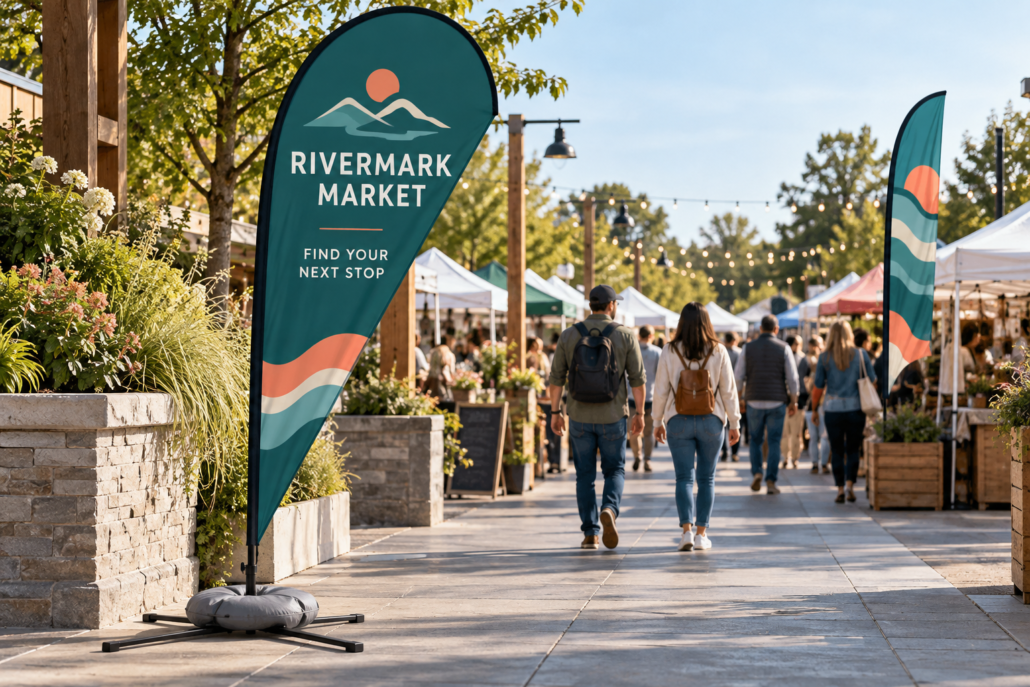
Choosing between a custom teardrop flag and a feather flag is often treated as a shape decision. That is too narrow. The better choice depends on where the display will stand, how people will approach it, what the message must do at a glance, and whether the hardware will still make sense when the order reaches the venue.
Both products can support branded events, retail promotion, sports environments, and other outdoor or display settings. The risk appears when a buyer selects a familiar silhouette before confirming the surface, traffic direction, construction, and message hierarchy. A display can look right in a supplier email and still be the wrong tool for the real site.
This guide gives event planners, print resellers, display companies, distributors, and brand teams a simple comparison. It uses the product facts that Vancke currently publishes, then separates those facts from practical site-planning inferences so the final inquiry is easier to quote and approve.

Start with the site surface, not the product name
The first question is physical: what will touch the ground?
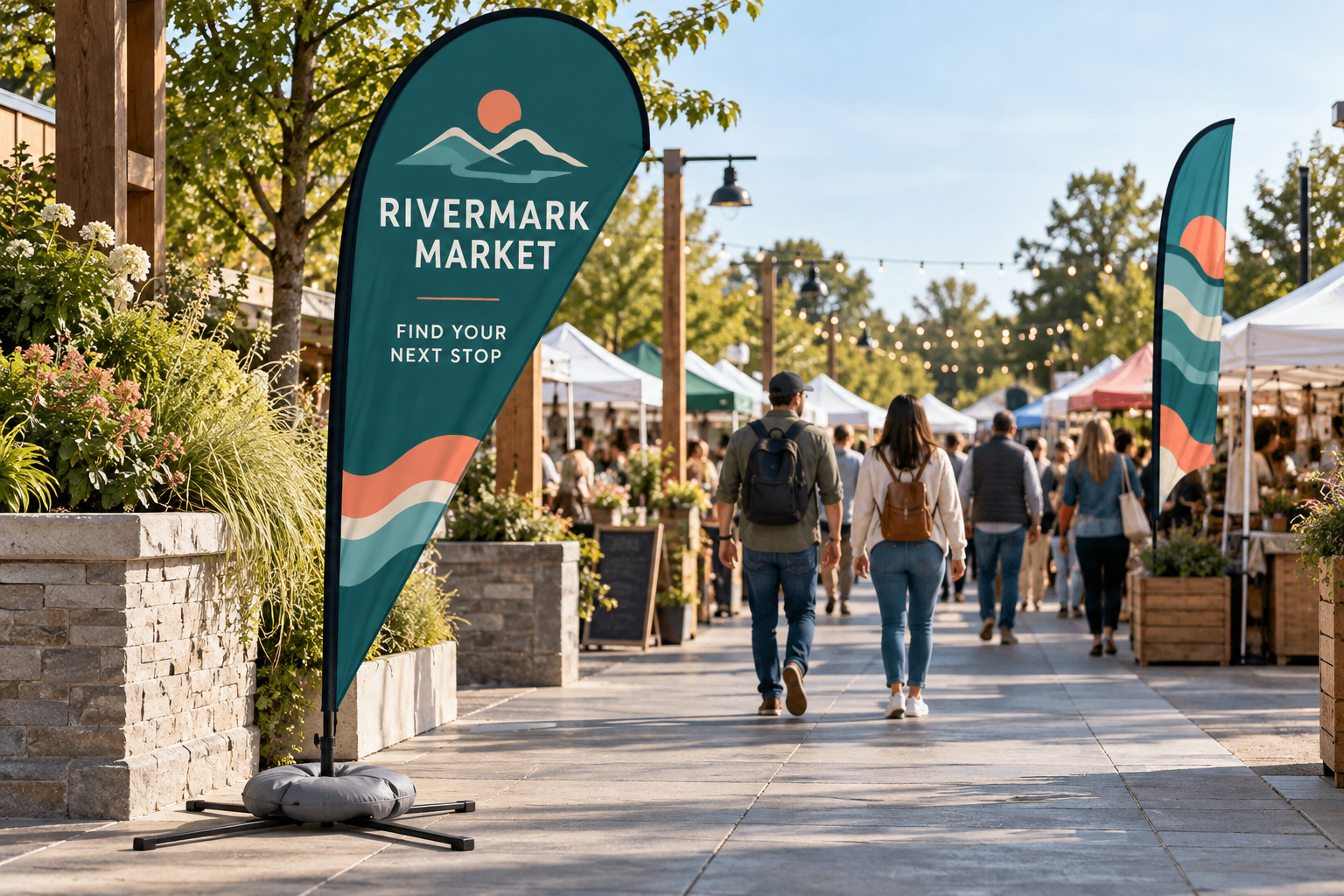
For indoor venues, paved entrances, concrete, and other hard flooring, the approved configuration for both custom teardrop flags and custom feather flags is a four-arm cross base with a refillable water-weight bag centered over the base around the pole. The base should be shown as a complete system: pole, fabric, cross arms, and weight all connected in a plausible way. Do not treat a square slab or a round pedestal as a substitute when the display is being planned for hard flooring.
For grass, soft soil, or sand, the approved configuration is a ground-spike base with its pointed shaft visibly inserted into the ground. The spike must be anchored in the surface, not placed on top of it. This distinction matters for the quotation, the artwork proof, the event brief, and the final setup check.
Vancke lists multiple base options for custom teardrop flags, and custom feather flags are available with bases for hard ground, soft ground, and vehicle-tire use. That does not mean every base is suitable for every site. Put the actual surface in the inquiry and ask for the exact configuration rather than ordering a generic flag and trying to solve the ground condition later.
Use the silhouette to match the message job
The second question is what the display must communicate while people are moving.
A custom teardrop flag uses a closed, tensioned teardrop-shaped graphic. Its lower edge closes back toward the pole, so the visible surface presents a contained, recognizable outline. A custom feather flag has a genuinely free lower fly. That creates a different visual rhythm: the fabric extends away from the pole at the bottom instead of closing into a teardrop.
The practical implication is an inference, not a product performance promise. A teardrop silhouette can be a strong fit when the buyer wants a compact, controlled brand shape at a storefront, event entrance, or trade-show aisle. A feather flag may be a better fit when the creative direction depends on the free lower fly and a more open flag profile. Neither shape automatically wins; the visitor path and the artwork have to decide.
Before choosing, sketch the display at the intended viewing distance. Mark the first word a passerby must recognize, the action they should take, and the direction they will approach from. If the design needs a large identifier and one short instruction, the proof should show those elements on the actual product shape rather than in a rectangular presentation mockup.
Choose the construction by the viewing direction
The third question is whether the message must read correctly from one side or from both.
Vancke offers single-sided and double-sided constructions for custom teardrop flags. Custom feather flags also have single-sided reverse and double-sided constructions. The correct choice depends on how the display sits inside the traffic pattern.
Use a single-sided construction only after checking what the reverse side will communicate to a visitor approaching from behind. A mirrored or less useful reverse view may be acceptable when the flag faces one controlled entrance. It is a risk when the display sits beside a two-way queue, a road, a sports sideline, or a booth aisle where people can approach from either direction.
A double-sided construction deserves consideration when correct reading from both sides is part of the buyer’s requirement. State that requirement plainly in the brief: “the brand name and call to action must read correctly from both directions.” That sentence is more useful than simply asking for “maximum visibility,” which does not tell the production team how the message will be judged.
For resellers, this is also where a small clarification prevents a larger revision. Ask the end customer whether the reverse side is allowed to be a mirrored image, whether two sides need different messages, and whether the display will be reused at a different venue. Record the answer before the artwork is approved.

Compare the two products by venue scenario
Use the following scenarios as a starting point, not as a substitute for the final site check.
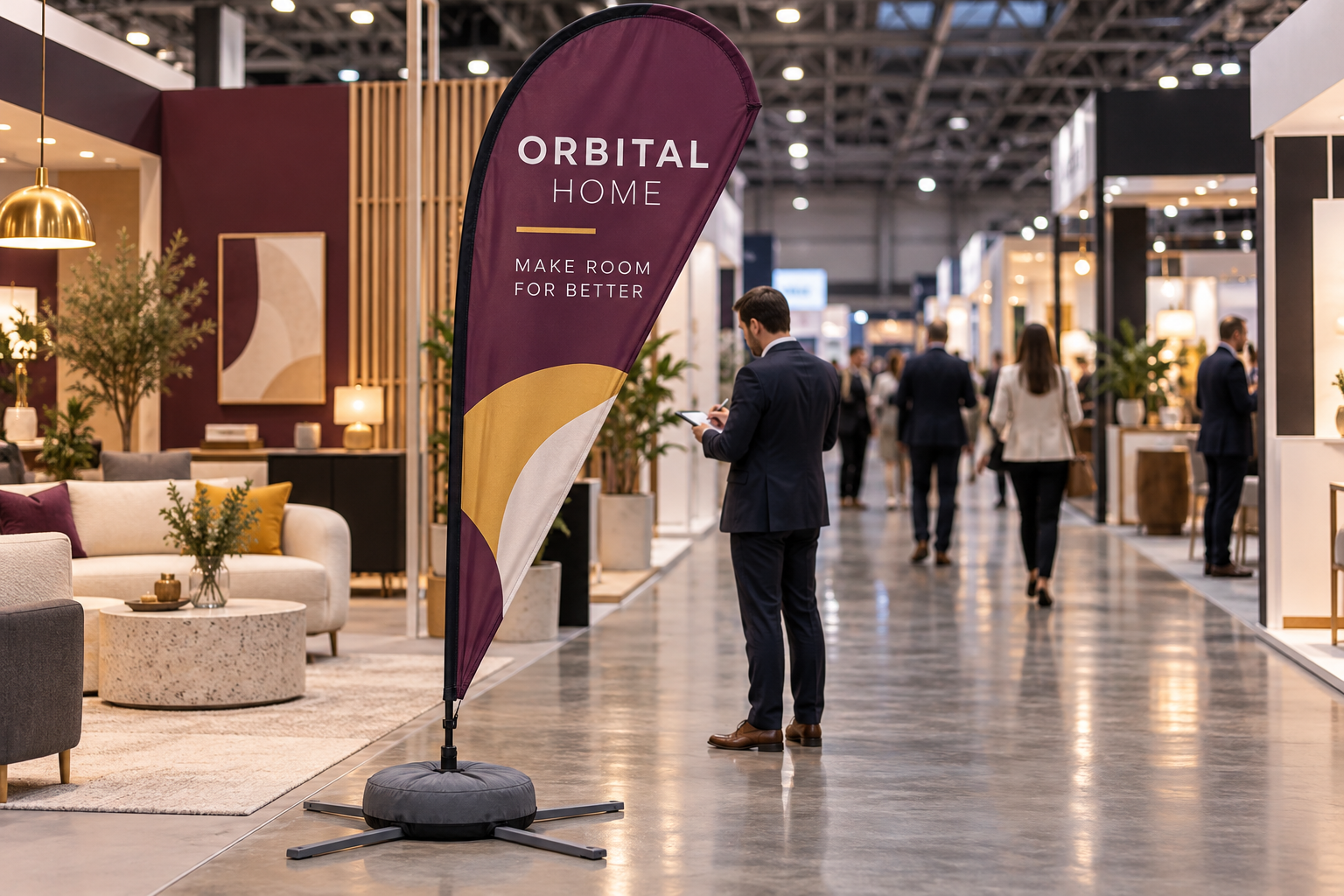
- Indoor trade show or exhibition aisle: Either shape can work. A teardrop flag may suit a contained brand mark and a clear aisle-facing message; a feather flag may suit a more open flag profile. Use the four-arm cross base and centered refillable water-weight bag on the hard floor, then review the actual sightline from the aisle.
- Grass sports event or community field: Either product can be planned with the approved ground-spike configuration. Confirm where the pointed shaft will enter, whether the event allows that anchor, and how the flag relates to the spectator or participant path.
- Retail entrance or roadside promotion: Start with the direction of approach. A teardrop flag can help when the buyer wants a closed, recognizable surface near a doorway or traffic lane. A feather flag can fit when the creative concept depends on the free lower fly. Treat both as site-specific choices, not interchangeable stock shapes.
- Reseller or multi-location campaign: Capture the product, size, construction, base, customer message, surface, and reuse plan in one request. This makes it easier to compare quotes and prevents a location-specific base choice from being copied to every branch.
These are planning inferences based on the physical differences between the products. They are not promises about traffic, sales, wind resistance, or a particular event result. Keep those claims out of the brief unless the buyer has separate evidence and a verified requirement.
Run three proof tests before you approve
A useful comparison is not complete when the product page looks attractive. Ask for a proof that survives three short tests.
- Surface test: Does the shown base match the actual floor or ground? Can you see the pole, fabric, ground contact, and weight or spike as one complete setup?
- Traffic test: From which direction will the first visitor approach? Is the brand identifier visible before the person reaches the display? What will the reverse side show?
- Message test: Can someone understand the main message without reading a paragraph? Is the call to action short enough for the viewing distance? If the flag is reused, will the wording still make sense at the next venue?
If a proof fails one test, do not solve the problem by adding more copy. First decide whether the product shape, side construction, base, or location is wrong. A revised proof should show the complete customer-facing result, not only a replacement logo or a loose text file.
Build the inquiry around the decision
When the choice is still unclear, send the supplier the information that changes the answer. Include the product options under consideration, the finished surface, indoor or outdoor use, the direction of visitor traffic, the required message, the preferred size, the single- or double-sided requirement, and the planned base. Add a photo or simple site sketch when the display will sit near a doorway, queue, fence, or vehicle route.
Ask for a digital artwork proof and price approval before production. Vancke’s published ordering flow starts with a request, then proof and price approval, payment, and dispatch. Treat the proof as a decision checkpoint: verify the shape, the message, the customer-facing colors, the selected construction, and the complete hardware configuration before approving it.
For outdoor planning, keep weather and surface conditions as separate checks. The National Weather Service explains that high winds can move objects and create safety risks; that general guidance does not define a safe operating limit for a particular Vancke display. Confirm venue rules and the supplier’s product-specific guidance instead of turning a product comparison into an unsupported safety promise.
If you need help turning an unfinished idea into a production-ready brief, review Vancke’s free design service. For the product comparison itself, start with the custom teardrop flag details and compare the shape, construction, sizes, and base options with the custom feather flag range.
Decision summary
Choose a custom teardrop flag when the closed, tensioned teardrop silhouette fits the message and the site proof shows a complete, suitable base. Choose a custom feather flag when the genuinely free lower fly supports the creative direction and the site conditions are equally clear. If both could work, let the traffic direction, side-legibility requirement, and reuse plan make the decision.
Your inquiry should end with one concrete request: “Please recommend the product, size, construction, and base for this surface and traffic path, then send a proof showing the exact customer message.” That gives Vancke something specific to quote and gives your team something specific to approve.