


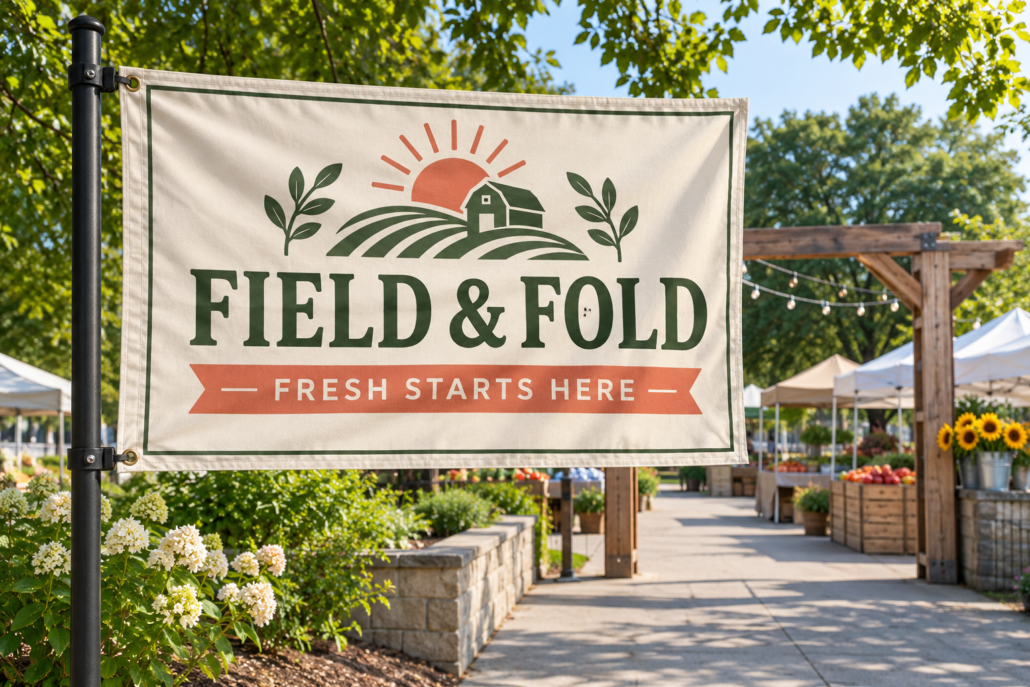
A custom flag quote can stall even when the buyer has already sent a logo and a rough quantity. The missing information is usually not the brand idea. It is the production context: where the flag will be used, which side must read correctly, how it will attach, what size is needed, whether the artwork is ready, and when the finished flags must arrive.
That gap creates a familiar loop. The supplier asks a question, the buyer checks with an event team, the artwork changes, and the original quote is no longer a reliable basis for approval. A better approach is to repair the brief before asking for a final price. Use the display job and the finished installation as the test for every decision.
This guide is for event planners, advertising production companies, distributors, print shops, and brands ordering custom flags. It is not a substitute for a supplier proof. It is a way to make that proof and quote easier to prepare, compare, and approve.
1. Start with the display job, not the word “flag”
Write one sentence explaining what the flag must help people do. Is it marking a market entrance, identifying a trade-show area, supporting a sports event, directing visitors to a registration point, or making a storefront easier to recognize? The answer determines what information deserves space on the fabric.
A wayfinding flag usually needs a short message that can be understood while someone is moving. A brand-identification flag may need the logo to dominate. A community event may need a name, date, and sponsor hierarchy. These are different artwork problems even when the buyer uses the same product name.
Put the job in the first line of the inquiry. “Three custom flags for the north entrance of a weekend market” gives a supplier more useful context than “Please quote custom flags.” It also gives the design proof a practical standard: can someone approaching the site understand the intended message?
2. Lock the size and viewing direction
Do not leave size as “standard” if the flag will be compared against a site, pole, wall, or entrance. Vancke’s custom flag page shows common options including 3 x 5, 4 x 6, and 5 x 8 feet, while noting that custom sizes may be available. Put the requested finished dimensions in the brief and ask the supplier to confirm whether the chosen size suits the intended installation.
Then describe where people will see the flag from. Will they approach from one direction, pass on both sides, or view it while moving along a route? This question affects whether a single-reverse construction is acceptable or whether the message needs to read correctly from both sides.
Do not solve an unknown viewing direction by adding more copy. First decide whether the flag has one primary face or two equally important faces. A shorter, clearer message is usually easier to approve than a crowded design that tries to serve every angle.
3. Choose single reverse or double sided deliberately
Vancke lists both single-reverse and double-sided custom flags. A single-reverse flag can show a mirrored image on the back. A double-sided flag is the better question when the message must be correctly readable from both directions, but the supplier still needs to confirm the construction and final artwork.
Write the decision in plain language: “The front is the priority; a reversed back is acceptable,” or “Visitors will approach from both sides; please quote a double-sided option.” This removes a common source of late revision because the proof reviewer knows what to inspect.
If several flags serve different jobs, do not force every unit into the same construction. List the quantity for each version and label the artwork files clearly. A site identifier, sponsor flag, and entrance message may need different priorities even when they ship together.
4. Decide how the finished flag will attach
An attractive artwork file does not answer how the flag will be installed. The product page lists canvas headers and grommets, as well as sleeve and grommet configurations. Choose the attachment approach before the artwork is treated as final, because the finished edge and hardware position are part of the physical display.
Describe the existing pole, wall, ceiling, or other support if one already exists. If the buyer is unsure, say so and ask for the recommended attachment configuration rather than selecting a fitting from a picture alone. Include a site photo or a simple sketch when the flag will replace an existing sign or share a structure with other graphics.
This is also where you separate custom flags from other display products. A rectangular custom flag may be right for a wall, pole, parade, event, or outdoor brand display, while a feather flag or teardrop flag uses different geometry and hardware. If the intended display is a tensioned standalone flag, confirm that the chosen product matches the site before artwork production begins.
5. Make the artwork checkable
Send the logo, message, colors, and any required sponsor marks together. State which elements are mandatory, which may be rearranged, and which must not be changed. If the artwork includes a date, location, URL, or offer, mark the exact approved spelling in the brief.
Vancke’s artwork requirements page explains preferred file types and notes that vector artwork is useful for scalable, crisp output. It also says the team can help convert artwork files for custom flags. That does not remove the buyer’s responsibility to check ownership and accuracy. The U.S. Copyright Office explains that copyright protects original artistic works, so use logos, photographs, and illustrations only when the project has the right to reproduce them.
For a difficult file, send the artwork before ordering and ask what can be used directly, what needs conversion, and what may need a new layout. You can also review the available artwork templates before the final file is prepared. The aim is not to make the buyer become a production artist. It is to surface technical questions while the schedule can still absorb them.
6. Keep the message short enough for the site
Custom printing gives a buyer flexibility, but flexibility is not the same as clarity. Build the design around one primary message. A useful order is brand or event name first, action or location second, and supporting detail only if it can be read at the actual viewing distance.
Ask the proof reviewer to check the flag in context, not only at 100 percent on a monitor. Does the logo remain recognizable? Is the message still legible when the fabric moves? Is the contrast strong enough for the intended background? Are sponsor marks subordinate to the main event identity? These are approval questions, not aesthetic preferences.
Keep a text-only version of the approved wording in the inquiry. That makes it easier to compare the proof against the source and reduces the chance that a late email introduces an untracked spelling change.
7. Put quantity and deadline in the same line
Quantity is not an administrative detail. It can affect the quote, artwork grouping, and timing. State the total quantity, how many designs are included, and whether each design has the same size and construction.
Then separate the event date from the required-arrival date. Vancke’s page describes standard production timing for smaller quantities and explains that shipping time is separate and varies by location and method. It also advertises fast shipping, but the safe planning move is to ask for a schedule tied to the actual destination. If the display is outdoors, check the local forecast and venue rules as the event approaches; the National Weather Service notes that high winds can move objects and create safety risks.
Write three dates: proof approval deadline, production deadline, and required-arrival date. If any date is fixed, say what happens if the proof is delayed. A supplier can only assess the schedule when the decision points are visible.
8. Treat proof approval as the release gate
Do not treat a digital proof as a formality. Vancke describes sending a design proof for confirmation before payment or production. Use that step to check the exact size, orientation, side construction, attachment method, artwork, colors, wording, quantity, and shipping destination.
Have one person own final approval. Collect comments before sending a consolidated revision request. “Please change the logo” is not enough; identify the file version, the requested placement, and whether the change applies to every design or only one unit. A clean approval record protects the buyer from approving an outdated version and helps the supplier act on one clear instruction.
Never approve a proof that still contains a question mark about the site. If the pole, sleeve, grommets, or viewing direction is undecided, the artwork is not ready for release.
9. Send a brief a supplier can answer in one pass
Use this compact structure in your inquiry:
- Display job: what the flag must identify or help visitors find.
- Location: indoor or outdoor setting, surface, support, and viewing direction.
- Size: finished dimensions requested, or the site constraint that needs advice.
- Construction: single reverse or double sided, plus the required attachment.
- Artwork: logo, message, colors, file link, rights status, and any template used.
- Quantity: total units, design count, and any size or construction split.
- Timing: proof deadline, required-arrival date, destination, and shipping questions.
- Approval: who will review the proof and what must be confirmed before production.
This brief does not force a product decision before the supplier sees the details. It does make the unknowns visible, which is the point. A useful inquiry invites a precise answer instead of hiding uncertainty behind a product name.
Turn the repaired brief into a quote request
If your existing custom flag inquiry has stalled, do not restart with a longer email thread. Rewrite it around the nine fields above, attach the current artwork, and identify the one decision that is still open. Then ask for the recommended construction, design proof, itemized price, production timing, and shipping estimate together.
Vancke’s custom flags page describes custom sizes, single- and double-sided options, attachment choices, free design support, and proof confirmation. When your brief is ready, send it through the contact form with the artwork and required-arrival date. The goal is not merely to receive a faster reply. It is to receive a quote that can be checked against the display you actually need to install.