


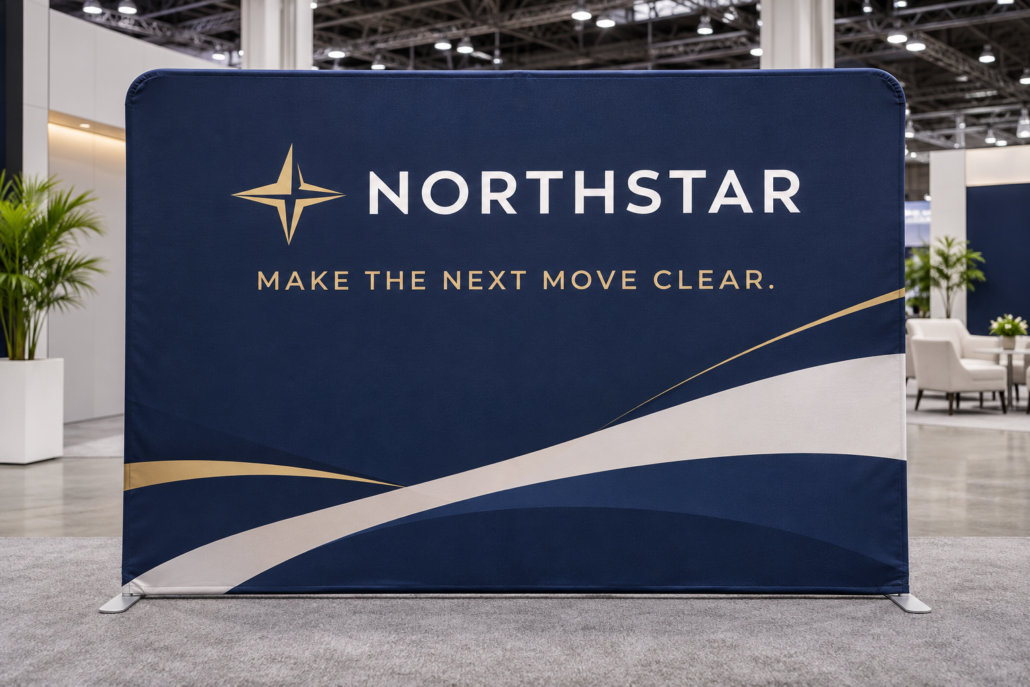
Tension Fabric Backdrop vs Tablecloth: Which Leads?
A booth can have both a branded backdrop and a custom tablecloth, but that does not mean both should carry the same message. When every surface tries to be the headline, visitors have to decide what matters before they understand the offer. The better decision is to choose one primary surface and give the other a supporting job.
Vancke describes tension-fabric backdrops for branded event and exhibition environments, including trade shows, photo areas, presentations, and branded event spaces. It describes custom tablecloths for tables used at trade shows, registrations, presentations, retail promotions, and events, with printed logos or brand graphics and multiple cover styles and sizes.
So the practical comparison is not “which product is better?” It is “where will the visitor meet the message first?” This guide helps event planners, exhibition companies, advertising production teams, distributors, print shops, and end brands decide whether the backdrop or the table should lead the booth identity, then turn that decision into a quote-ready brief.
The decision in one view
| If the visitor’s first interaction is… | Let this surface lead | Give the other surface this job |
|---|---|---|
| Entering a branded space or viewing a presentation | Tension fabric backdrop | Keep the tablecloth quiet and make the table easy to identify. |
| Approaching a staffed registration or information table | Custom tablecloth | Use the backdrop to reinforce the brand without competing with the desk interaction. |
| Taking a photo or standing for a conversation | Tension fabric backdrop | Use the tablecloth for a short secondary identifier or supporting mark. |
| Moving through a compact booth with a clear service point | Whichever surface meets the visitor first | Reduce the second surface to a supporting role rather than repeating the headline. |
This is a message-hierarchy decision. It does not replace the supplier’s recommendation on the final product, available styles, artwork, quantity, or delivery plan. It tells the supplier which visitor action the display must support.
Start with the visitor’s first stop
Draw the booth as a sequence, not as a product photo. Where does a visitor first slow down? At the entrance? In front of a speaker? Beside a registration table? At a product sample? The first stop should usually meet the clearest version of the brand message.
If people enter the space and see a presenter, photo area, or product demonstration before they reach the table, the backdrop has a strong case for being the lead surface. It can establish the branded environment behind the activity. The tablecloth can identify the support point without asking visitors to read two competing headlines.
If the booth is organized around a staffed table, the tablecloth may deserve priority. A registration desk, sample table, or information counter gives the visitor a concrete place to act. The backdrop then supports recognition from farther inside the space, but it should not make the visitor wonder whether the table or the wall is the real destination.
Write the first-stop sentence in the inquiry: “Visitors first meet our presenter,” or “Visitors first approach the registration table.” That sentence is more useful than saying only “We need branded event graphics.”
When the backdrop should carry the main message
Choose the tension-fabric backdrop as the lead when the brand needs a defined visual field behind a person or activity. A trade show conversation, presentation, photo area, and branded event space all benefit from knowing what should sit behind the interaction. The backdrop becomes part of the setting rather than a label attached to one object.
Use one primary idea on that surface: the company or event name, the main promise, or the short message that should remain in photographs. Supporting details can live on a handout, screen, product sample, or conversation. The more people move in front of the graphic, the more important it becomes to decide which words must remain visible around them.
In the brief, describe the action in front of the backdrop. Will a speaker stand there? Will visitors pose for photos? Will a sales team hold conversations? Will a product demo move across the space? The answer helps the supplier understand why the backdrop is the primary surface and helps the design team protect the important message from being hidden.
Vancke’s tension-fabric backdrop page describes a fabric graphic fitted over a supporting frame. Ask for the recommended configuration for the available space, then review the proof in the position where people will actually stand. A layout that looks balanced on a screen may need a different message hierarchy when a presenter or visitor occupies the center.
When the tablecloth should carry the main message
Choose the custom tablecloth as the lead when the table is the action point. Registration, information collection, product display, retail promotion, and staffed presentations all make the front of the table part of the visitor’s decision. The brand should be easy to recognize where the visitor is expected to stop.
State what the visitor should do at the table: register, ask for a sample, collect a brochure, book a follow-up, or speak with a representative. Then keep the front-facing message short enough to work at the approach distance. The tablecloth does not need to repeat every detail that appears on the backdrop or on the printed material.
If a backdrop is also present, make it support the table’s job. It might carry the broader brand identity while the tablecloth identifies the service point. Or it might carry a quiet pattern while the tablecloth carries the event name. Decide the order before the artwork is prepared; otherwise the same logo and headline may be enlarged across every surface without a clear reason.
Vancke’s custom tablecloth page lists multiple table-cover styles and sizes. Include the table dimensions and intended use in the inquiry, then ask which style is suitable for the display. The design proof should be reviewed on the table shape and from the visitor’s approach direction, not only as a flat artwork file.
Use both products without creating two headlines
There is a useful role for a backdrop and a tablecloth together. The problem is not duplication by itself; it is duplication without hierarchy. Give each surface a different question to answer:
- Backdrop: What brand or event space has the visitor entered?
- Tablecloth: Where should the visitor stop and what happens there?
That split makes the booth easier to scan. The backdrop can carry the broader identity of the environment. The tablecloth can make the service point visible. If the same headline appears on both, reduce one surface to a supporting version rather than allowing the repetition to dominate the booth.
Check the hierarchy from three positions: the approach path, the conversation position, and the photograph position. At the approach path, the visitor should know what the booth is. At the conversation position, the visitor should know where to act. In a photograph, the primary brand should remain recognizable without a second headline fighting for attention.
Compare the two surfaces with five questions
Use the same questions for both candidates before requesting a quote:
- First contact: Which surface does the visitor see or approach first?
- Visitor posture: Will the visitor stand, sit, register, photograph, or walk past it?
- Message responsibility: Is the surface explaining the brand space or directing the action point?
- Visibility risk: Could a person, table object, screen, or display sample hide the main message?
- Proof test: Can the team review the design in the actual booth position before approving it?
Score each surface against the five questions and write the reason for the winner. The score is not a product rating. It is a record of why the chosen surface should lead this particular visitor journey. It also gives a supplier enough context to question a weak assumption before production.
Prepare the artwork around the hierarchy
Before sending files, identify the exact wording that cannot change, the elements that may be rearranged, and the details that are optional. Mark the primary message separately from the supporting message. If the backdrop leads, do not let the tablecloth become a second poster. If the tablecloth leads, do not let the backdrop hide the service point behind a long paragraph or a competing call to action.
Review Vancke’s artwork requirements before supplying artwork. If the design includes a logo, photograph, or illustration from another party, confirm that you have permission to reproduce it; the U.S. Copyright Office FAQ is a useful starting point for that rights check.
Keep a text-only copy of the approved wording with the inquiry. It makes the proof easier to check and reduces the chance that a late email changes the headline on one surface but not the other. The proof should show the exact customer brand and message on the intended product, not just a generic layout.
Put the decision into a quote-ready brief
Send the supplier these fields together:
- the first visitor stop and the action that should happen there;
- whether the tension-fabric backdrop or custom tablecloth is the primary surface;
- the supporting job of the second surface, if both are planned;
- available floor width, table dimensions, booth restrictions, and viewing directions;
- quantity, number of designs, and whether the same hierarchy applies to every unit;
- approved brand assets, message hierarchy, artwork status, and proof approver;
- event date, required-arrival date, destination, and latest proof deadline.
Ask for the recommended product details, available options, itemized pricing, proof, production timing, and shipping estimate. If the site information is incomplete, say which decision is still open. A good brief makes uncertainty visible instead of hiding it behind the phrase “branded booth.”
Choose the lead surface, then ask for the right quote
A tension fabric backdrop is the better lead when the booth needs a branded background for a presentation, photo area, trade show conversation, or event space. A custom tablecloth is the better lead when visitors are expected to approach a table to register, ask questions, view samples, or begin a service interaction.
If both are part of the plan, make the hierarchy explicit: the backdrop explains the space, and the tablecloth identifies the action point; or reverse that order when the table is the first stop. Then ask Vancke to recommend the available configuration and prepare a proof that shows the products in their actual roles.
When your brief is ready, review the tension fabric backdrop page, compare it with the custom tablecloth page, and send the visitor journey, artwork status, quantity, and required-arrival date through Vancke’s contact form. The useful outcome is not two matching products. It is one clear booth message and a quote your team can approve with confidence.