A feather flag can be printed correctly and still create a problem at the venue. The usual gap is not the artwork file. It is the handoff between the person who approves the display and the person who has to carry, assemble, position and monitor it on event day.
A venue may have polished flooring instead of grass. The field team may receive the fabric and pole but not the right base. A message that looked clear in a flat proof may face the wrong visitor direction. These are procurement and operations failures, not reasons to add more words to the flag.
Before requesting a custom feather flag, create a short handoff brief that describes the real site and the real job. The brief gives the supplier enough context to discuss the complete display, while giving the event team a simple reference for setup.
Separate the artwork approval from the setup approval
Artwork approval answers one question: does the customer-facing design look right? Setup approval answers another: can the intended team deploy the complete display in the intended place with the intended message facing the visitor route?
Do not treat a digital proof as evidence that the event plan is complete. The proof cannot show whether the flag will stand on grass, concrete, tile or another hard surface. It cannot show whether the pole, fabric, base and carry bag have been assigned to the same person. It also cannot show whether a single-sided print is enough for visitors approaching from both directions.
Keep both approvals in the same job folder, but label them separately. One file can be the approved artwork. The other can be a site photograph or venue plan annotated with the surface, display position, visitor approach and person responsible for assembly. If any of those conditions changes, reopen the setup check instead of assuming the old approval still applies.
Write the surface in plain language
The first line of the brief should describe what the bottom of the pole will actually meet. “Outdoor event” is not enough. A sports venue may have grass at the entrance and concrete near the registration desk. A trade show may have carpet in one area and polished flooring in another. The base decision follows the actual surface, not the event category.
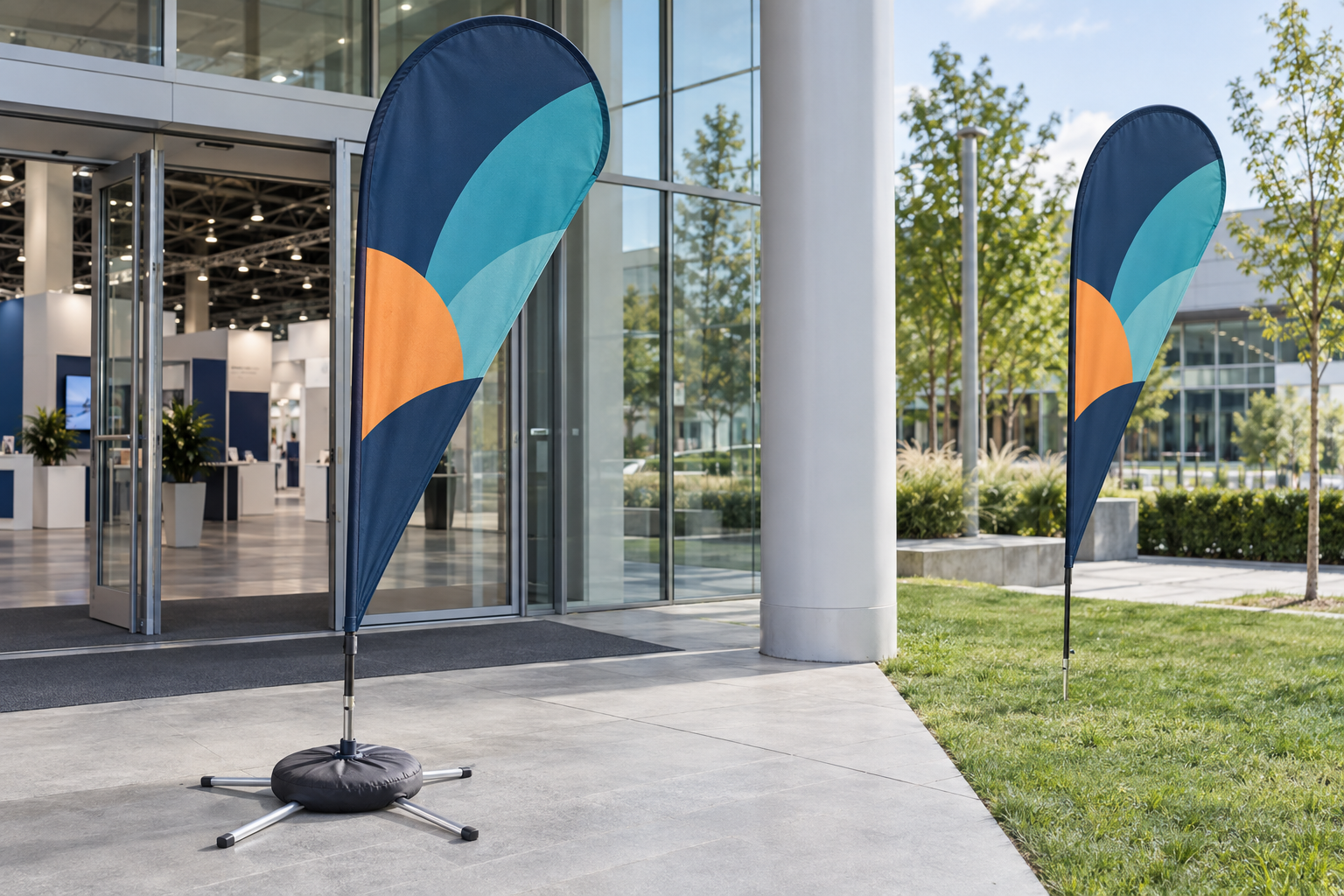
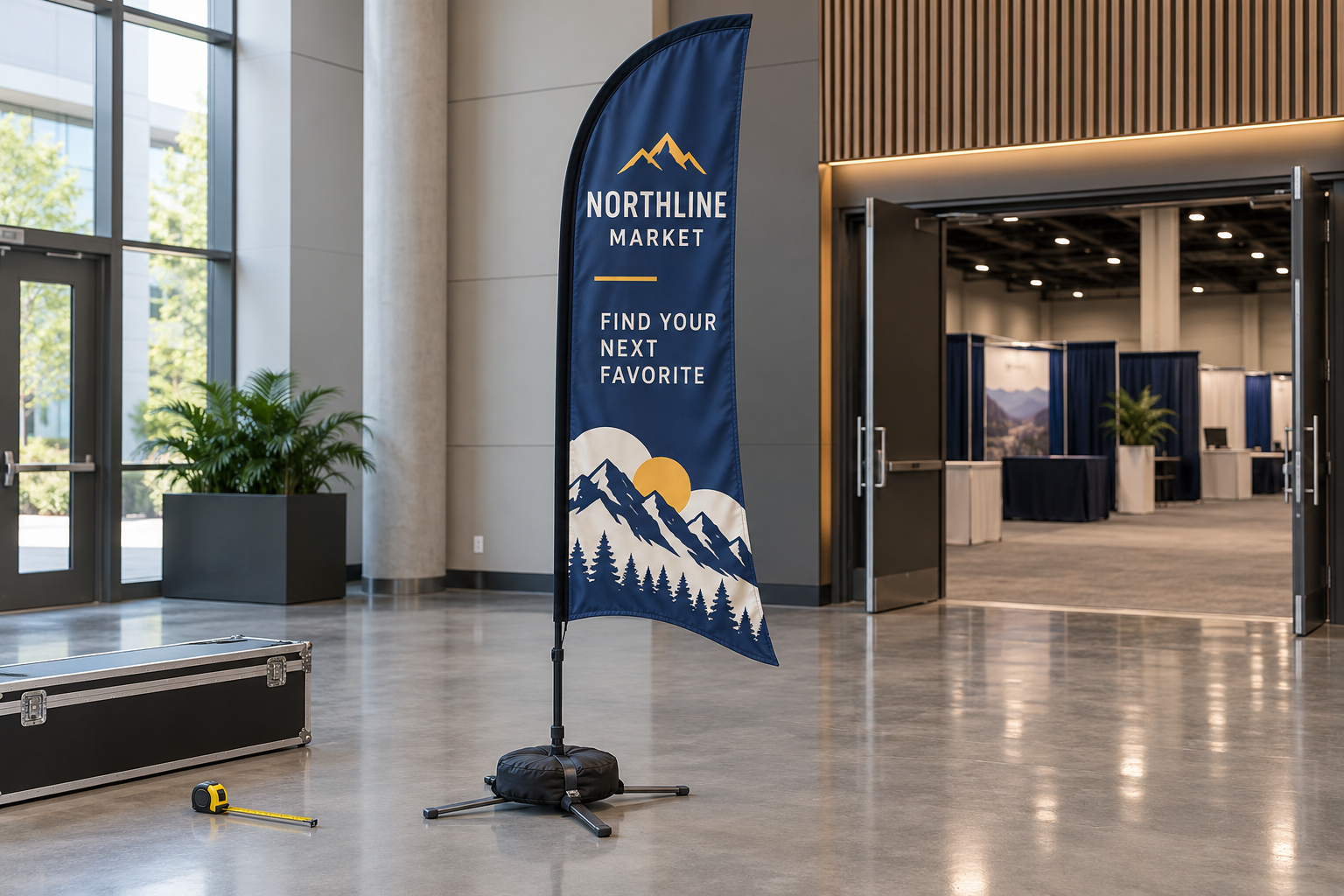
For indoor or other hard flooring, the approved configuration is a four-arm cross base with a refillable water-weight bag centered over the base around the pole. The arms, pole connection and bag should travel as one planned display. A standalone slab or a base chosen only because it appears convenient in a catalogue is not a substitute for a complete, site-matched configuration.
For grass, soft soil or sand, the approved configuration is a ground-spike base with its pointed shaft visibly inserted into the ground. Put that fact in the brief and show it in the site reference. A spike resting on top of grass is not installed; it leaves the most important physical connection unresolved.
If the team will work across several surfaces, list each location separately. Do not ask one generic order to cover “indoor and outdoor use” without saying which base belongs to which stop. That shortcut creates avoidable questions when the crew is already unloading.
Name the complete kit and the person carrying it
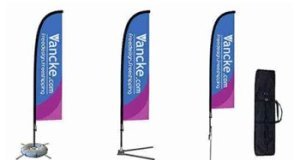
A custom feather flag is not just a printed fabric panel. Vancke describes a complete set as the custom flag, base, pole set and carry bag. Your handoff brief should repeat those four components and assign ownership for transport, setup and pack-down.
- Fabric: record the approved design name and whether the display is single-sided or double-sided.
- Pole set: record where the pole sections are stored and who checks the connection before the display is raised.
- Base: state cross base plus water bag for hard flooring, ground spike for soft terrain, or the vehicle-tire option where that is the confirmed site condition.
- Carry bag: keep it with the rest of the kit so the display has a defined route back into storage.
- Owner: name the person or team that signs off the physical setup, not only the person who approved the artwork.
This list is deliberately operational. It does not promise that the display will suit every weather condition or every venue rule. It makes the remaining questions visible while there is still time to answer them.
Choose the viewing direction before choosing the message hierarchy
Ask where the first visitor will come from and where the next visitor will stand. If the flag is positioned along one approach, a single-sided print may be sufficient for the brief. If both sides need to read correctly in a high-traffic area, Vancke offers a double-sided construction with two printed faces and a blackout middle layer.
That is not merely a print preference. It changes what the crew should check on site. Mark the primary viewing direction on the venue photograph. Then confirm whether the message still reads when the fabric is moving and when the visitor is several metres away. Keep the copy short enough to function as a wayfinding or recognition cue; do not turn a feather flag into a full sales page.
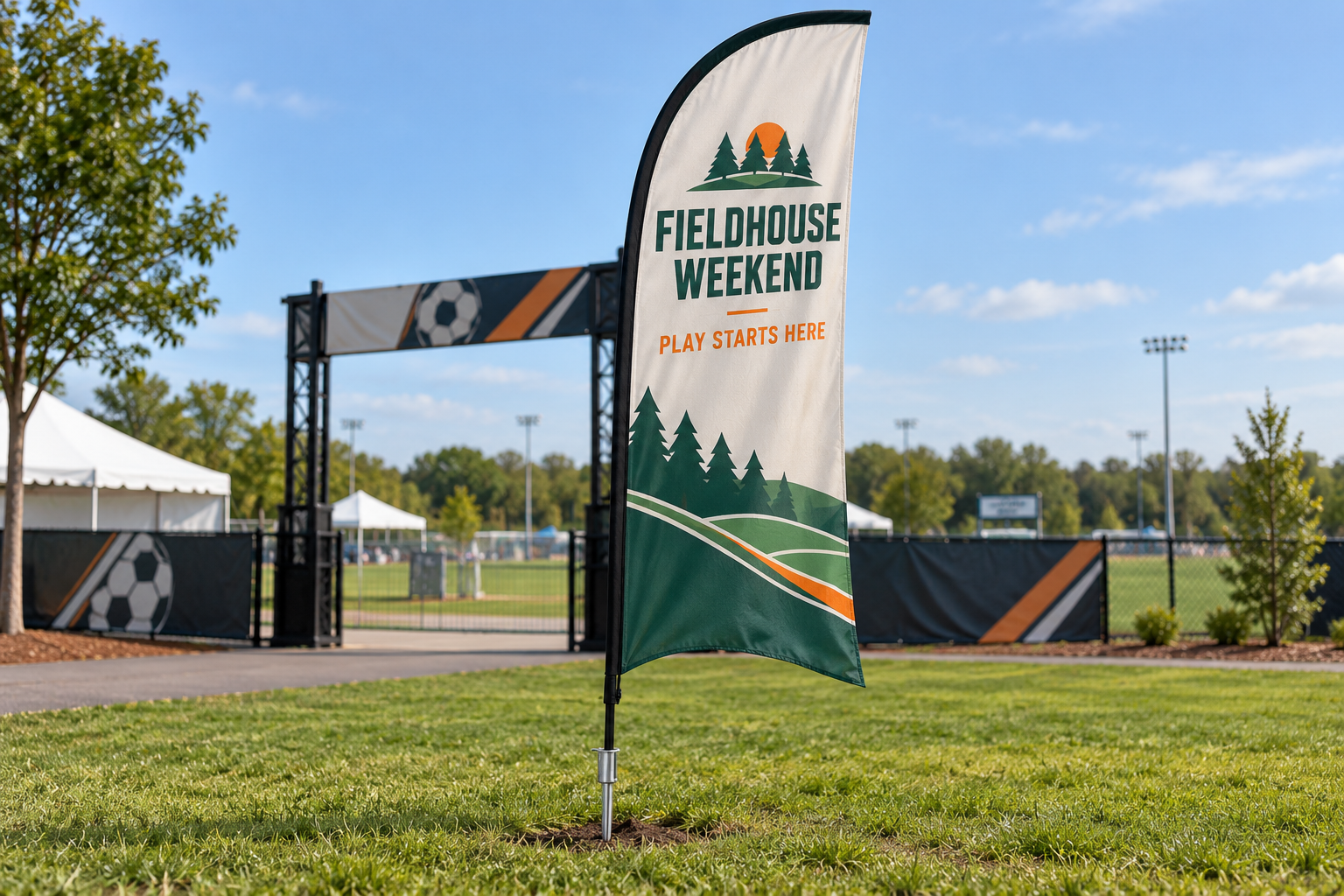
Use the customer-facing surface for the customer brand and the one action or idea the display is meant to support. The illustrations in this article use fictional brands—NORTHLINE MARKET and FIELDHOUSE WEEKEND—to show the principle. They are not customer projects or performance evidence.
Turn the brief into a five-minute setup check
On arrival, the setup owner should be able to answer five questions without reopening the entire email thread:
- Is this the correct venue zone and visitor approach?
- Is the surface the same as the approved brief?
- Are the fabric, pole set, matching base and carry bag all present?
- Does the printed message face the route it was designed for?
- Is the display outside the venue’s restricted path, access zone or other local rule?
Take one photograph after assembly that shows the entire flag, its ground contact and the surrounding path. A close crop of the fabric proves very little about the setup. The photo should allow the project owner to see whether the hardware is complete, whether the lower fly remains free, and whether the message is readable from the intended approach.
For an outdoor event, add a weather decision to the operating brief. The National Weather Service wind-safety resource explains that high winds can move objects and create safety risks. That reference does not define a safe operating limit for your specific display; follow the venue’s instructions and the supplier’s product guidance, and define who can pause or remove the display when conditions change.
Resolve unknowns before production, not at the gate
A useful inquiry gives the supplier enough information to identify the open decisions. Send the site surface, a location photograph, the visitor approach, the required size, the intended print direction, the quantity, the event date and the delivery requirements. If the flag will move between locations, list every relevant surface and say which hardware is needed at each one.
Vancke lists several feather-flag sizes and base styles, and its ordering flow includes a proof-and-price approval before production. Use that conversation to confirm the selected configuration and the artwork together. If you are unsure whether a venue description means hard flooring or soft terrain, ask the venue for a photograph rather than guessing from its event name.
For agencies, distributors and event teams handling several brands, keep the customer artwork, installation brief and final proof tied to the same job reference. That prevents a crew from taking the right hardware to the wrong flag or carrying a previous event’s assumptions into a new site.
Make the inquiry easy to answer
When you are ready to review a custom feather flag, send Vancke the measured or confirmed display area, surface photographs, visitor direction, artwork, quantity, event date and delivery requirements. Use the free design and quote request to ask the team to review the complete handoff: printed message, pole set, base, carry bag and setup conditions.
The commercial goal is not simply to order a flag. It is to receive a display that your team can identify, carry, assemble and position without inventing missing decisions at the venue. A short, accurate handoff brief protects the artwork, the schedule and the quality of the inquiry that follows.