A custom logo tablecloth is one of those trade show purchases you only want to make once.
If you’re in “we need this for the next event” mode, this guide is built for decision-stage buyers: pick the right table throw size (4ft/6ft/8ft), choose open-back so staff can sit behind the table, keep it washable for repeat events, and avoid flame-retardant surprises at the venue.
Start here: are you sure you want a table throw?
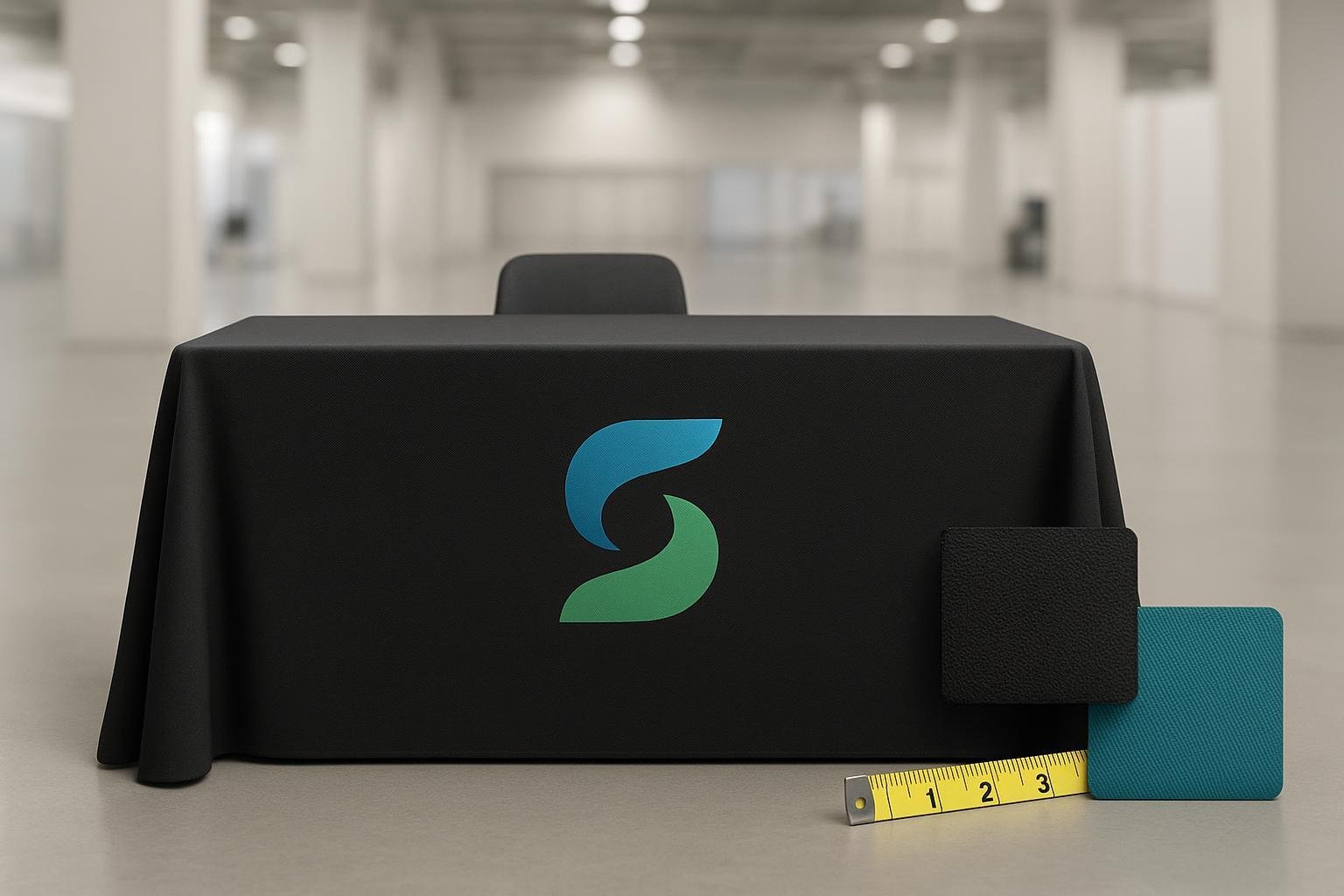
A branded table throw is the classic, loose-drape style. It’s usually the safest choice when you don’t control the exact table you’ll get at every event.
A quick comparison:
Table throw (draped): flexible fit, hides under-table storage, fastest setup.
Fitted cover: tailored corners, cleaner lines, but requires exact sizing.
Stretch/spandex cover: tight, modern look, very wrinkle resistant, but seam alignment matters and sizing still needs to be correct.
If your priority is open-back seating + storage access + fewer sizing headaches, a table throw is hard to beat.
1) Choose the right size (4ft, 6ft, 8ft) and confirm the table you actually have
Most “standard” trade show tables fall into a small set of sizes:
4ft table: typically 48″ long (often narrower; common as demo tables)
6ft table: typically 72″ long (one of the most common sizes)
8ft table: typically 96″ long (also very common)
Many standard venue tables are around 30″ wide and ~29″ high. That’s why most table-cover sizing guidance centers around those dimensions.
To avoid the most common mistake (ordering based on the venue’s “6-foot table” label only), measure three things:
Length (48/72/96 inches)
Width (often 24″ or 30″)
Height (often around 29″)
Even with a loose table throw, these three measurements tell you whether you’ll get a clean drape or annoying “puddling” at the corners.
For sizing reference and typical trade show table dimensions, see:
Example throw sizing for an 8ft standard table: 90″ × 156″ throw size guidance
Pro Tip: If you’re buying for multiple events, confirm whether your events consistently provide 6ft tables, 8ft tables, or a mix. “Multiple sizes” often means you either need two throws, or an adjustable throw designed to work across both.
2) Open-back vs closed-back: pick based on seating and access
You called out open-back for seated staff, which is exactly the right spec for:
registration/welcome tables
small booths where staff sits behind the table
any setup where you need to reach under the table quickly
Open-back table covers (also called 3-sided) cover the top, front, and two sides. The back is open, so a chair can slide in and supplies are easy to grab.
Closed-back (4-sided) looks more “finished” from every angle, but it slows you down when you need access under the table.
If the table will be visible from all angles (island booth, table in the center of a space), closed-back can be worth it. Otherwise, open-back is the practical default.
Reference for open-back vs closed-back definitions: Custom trade show table covers overview
3) Material + printing: what matters for a table throw (and what doesn’t)
For a trade show table throw, you’re mostly buying:
drape (does it hang cleanly?)
print clarity and color (does your logo look sharp under event lighting?)
durability (how many events will it survive?)
maintenance (can your team wash it quickly between events?)
Most modern branded throws use full-color dye-sublimation printing because it handles gradients and photographic backgrounds well.
When you compare vendors, ask these two questions early:
What’s the fabric composition and weight? (This affects drape and how forgiving wrinkles are.)
Is the print dye-sublimated, and is it printed edge-to-edge? (This affects what designs are feasible.)
If you’re sourcing from Vancke, their custom tablecloth page lists dye-sublimation printing and multiple styles/sizes.
4) Washability: how to keep your branded table throw looking new
“Machine washable” is common, but outcomes depend on how your team washes it.
Practical rules that prevent 90% of regrets:
Wash in cool water with mild detergent
Use a gentle cycle (low mechanical action)
Air-dry when possible, or tumble dry on low heat
Make sure it’s fully dry before storing
Avoid:
hot water
high dryer heat
bleach
Good, specific care references:
⚠️ Warning: If flame-retardant performance is required for your venue (next section), ask the vendor whether wash cycles affect compliance documentation or labeling, and what they recommend for ongoing compliance.
5) Flame-retardant requirements for a custom logo tablecloth: what to ask for (without guessing)
You asked for a flame-retardant tablecloth. In the U.S., that usually means the venue (or the authority having jurisdiction) expects event textiles to meet a recognized test standard, and they want proof.
One of the most commonly referenced standards for event textiles is NFPA 701, which is a standard test method for flame propagation of textiles and films.
NFPA’s overview: NFPA 701 standard
Two important realities:
Requirements vary by venue and location. There isn’t one universal rule that every event uses.
“Flame retardant” on a product listing isn’t the same as having documentation accepted by the venue.
A practical guide to how flame-retardancy compliance varies in the U.S. and what buyers should do: Sew What Inc on navigating U.S. flame-retardancy regulations
The documentation checklist (send this to any vendor)
Ask for:
A certificate that states the relevant standard (for example, NFPA 701) and the product/fabric covered
A test report from an acceptable testing organization (or an equivalent proof accepted by the venue)
Any labels/tags that ship with the product (some venues look for labeling)
If the vendor can’t provide this clearly, treat it as a risk, not a detail.
One video that explains the standards
6) Artwork + proofing + timing: the decision-stage workflow
Once you’ve nailed your size + open-back + compliance needs, the workflow should be straightforward.
A buyer-friendly ordering sequence:
Confirm table size(s) you’re ordering for (4ft/6ft/8ft) and whether you need open-back.
Send artwork (logo files + brand colors). If you have a vector file (AI/EPS/PDF/SVG), include it.
Review a digital proof and confirm what “approved” means (color, logo placement, safe margins).
Confirm production + shipping timeline based on your event date.
Vancke’s stated workflow includes proof approval before production and multiple table sizes.
If shipping time is a deciding factor, also review: Vancke free worldwide shipping.
For faster approvals, give your designer a template when possible: artwork templates.
7) Vendor shortlist checklist (and the red flags to avoid)
If you’re comparing vendors, use this as your “final round” checklist.
Must-haves
Correct size options (4ft/6ft/8ft) and the ability to confirm dimensions
Open-back option for seated staff
Clear print method and material description
Washability with written care instructions
If required: flame compliance documentation (certificate + test report)
Proofing step before production
Confirmed production + shipping timeline to your event date
Nice-to-haves
Easy reorders (saved artwork + repeatable specs)
A carry bag or protective packaging for travel
Clear policies on proof-to-print color matching expectations
Red flags
“Flame retardant” promised but no documentation offered
Vague sizing (“fits most tables”) with no measurements
No proofing step before print
Unclear lead times (“ships fast”) with no production timeline
Next steps
If you’re ready to place the order, here’s the fastest way to do it without back-and-forth:
Pick your table size(s): 4ft, 6ft, 8ft
Confirm open-back
Confirm whether your venue requires NFPA 701 (or another standard) and request the certificate/test report
Send artwork and request a proof for approval
If you want a single vendor path to quote against those specs, start here: Vancke custom tablecloth.
Key Takeaway: For most trade show teams, the right “custom logo tablecloth” decision comes down to four checks: correct table size, open-back access, wash-safe care, and venue-accepted flame documentation.
FAQ
What size custom table throw do I need for a 6-foot table?
A standard 6ft trade show table is typically around 72″ long, and many venues use tables about 30″ wide and ~29″ high. Confirm your exact width/height before ordering, then choose a 6ft throw designed for that table size.
Should I choose open-back or closed-back for a trade show booth?
Choose open-back if staff will sit behind the table or you need frequent access to storage. Choose closed-back only when the table is visible from all directions and you need the cleanest look.
How do I wash a branded table throw without ruining the print?
Use cool water, mild detergent, a gentle cycle, and low heat (or air dry). Avoid bleach and high heat. Always dry completely before storing.
Does a “flame retardant tablecloth” automatically meet venue rules?
Not automatically. Venues may require a specific test standard (often referenced as NFPA 701 for textiles) plus documentation (certificate/test report). Confirm your venue’s requirement and request documents up front.